HR & Recruiter Cover Letter Examples
HR and recruiting candidates write the most-scrutinised cover letters in hiring — the reader screens applications for a living and has seen every template. These examples, from recruiter and HR generalist to HRBP and talent acquisition specialist, are built to survive that reading: they lead with time-to-fill, retention, and program numbers instead of a paragraph about being a people person.
The credibility test in an HR letter is whether you describe your work the way the function measures itself. Recruiters are measured on requisitions carried, time-to-fill, offer-accept rate, and source quality; generalists and HRBPs on retention, ER case handling, program adoption, and compliance. A letter that speaks that language marks you as an operator; one that speaks about passion for people marks you as an applicant.
Build My Cover Letter Free12 HR & Recruiting Cover Letter Examples
Every letter below is complete and specific to its role. Open any of them in the builder and edit each line — nothing here is a placeholder.
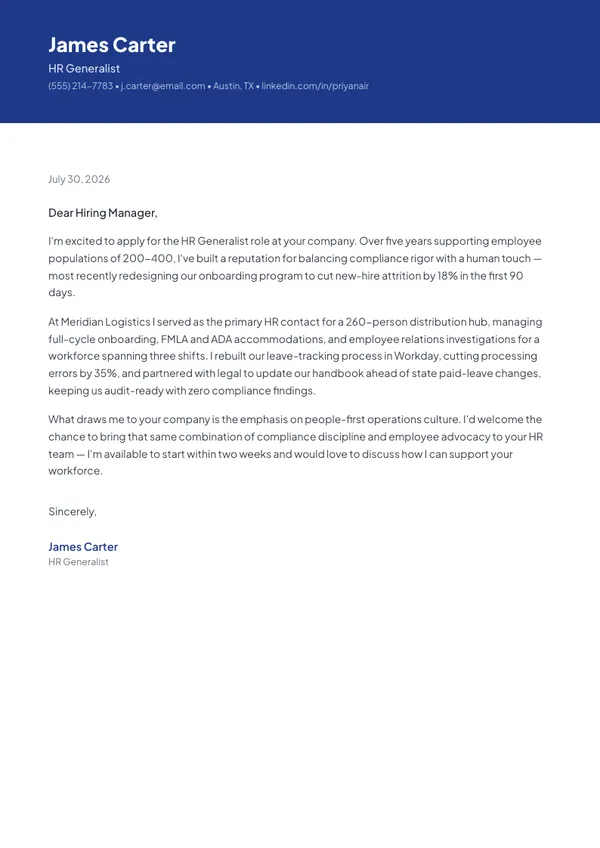
HR Generalist
Executive template
View example →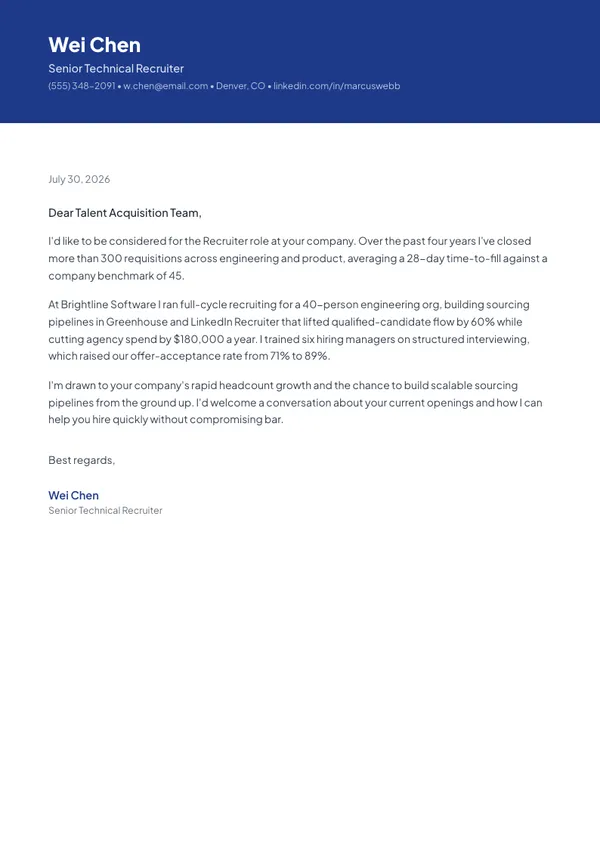
Recruiter
Executive template
View example →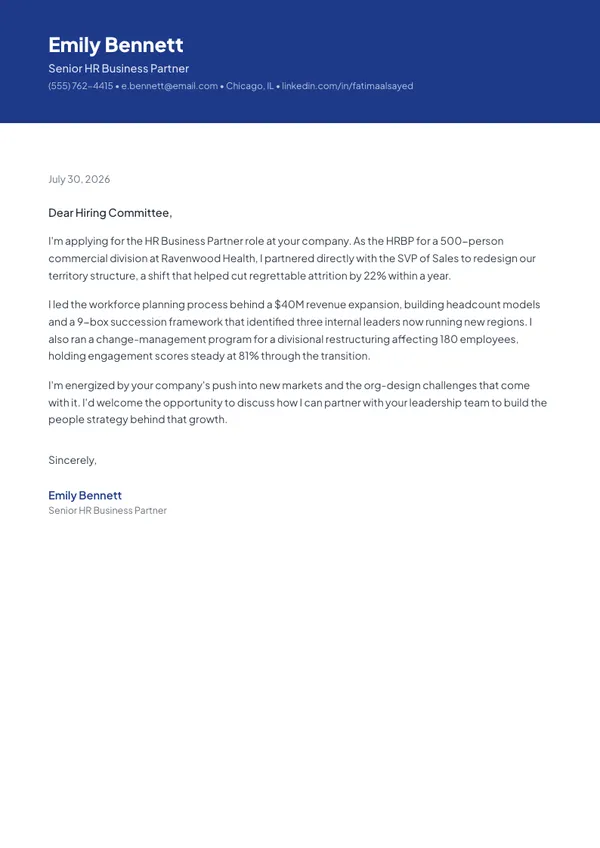
HR Business Partner
Executive template
View example →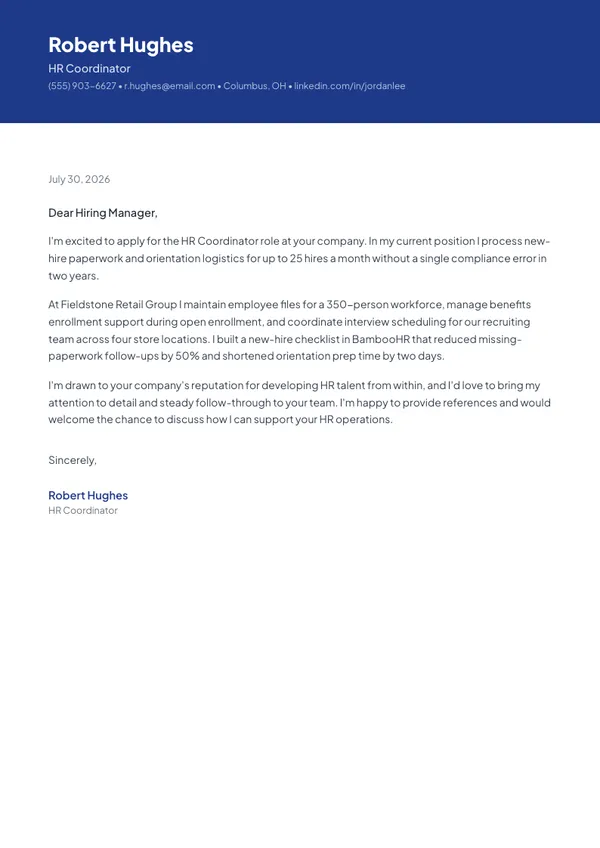
HR Coordinator
Executive template
View example →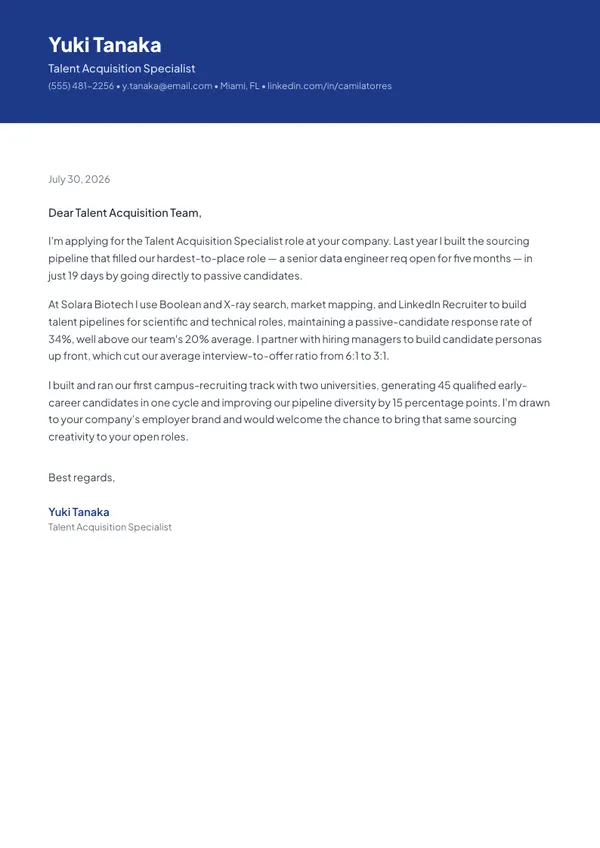
Talent Acquisition Specialist
Executive template
View example →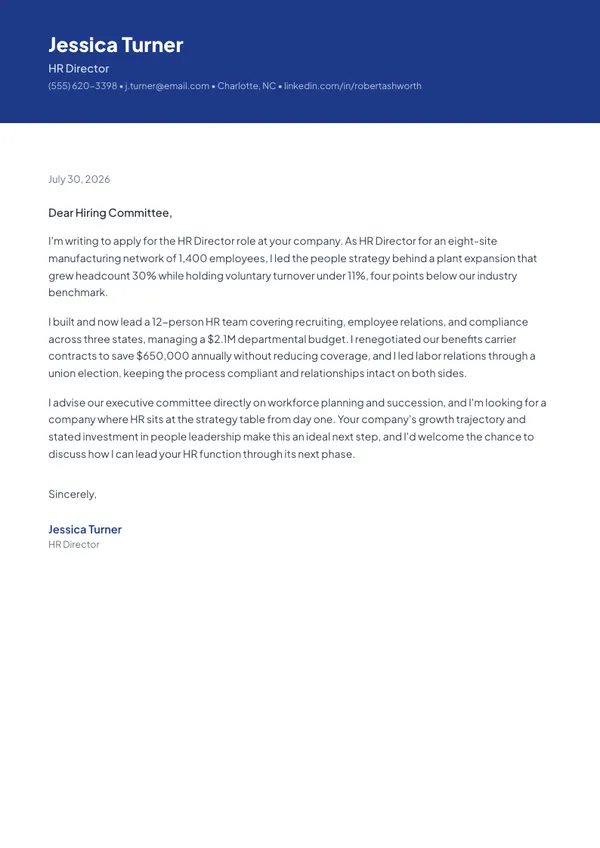
HR Director
Executive template
View example →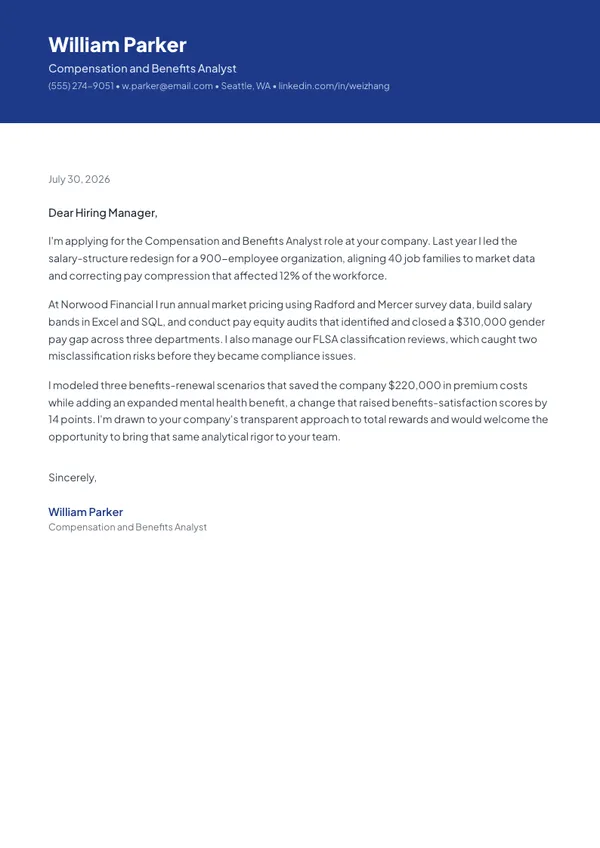
Compensation and Benefits Analyst
Executive template
View example →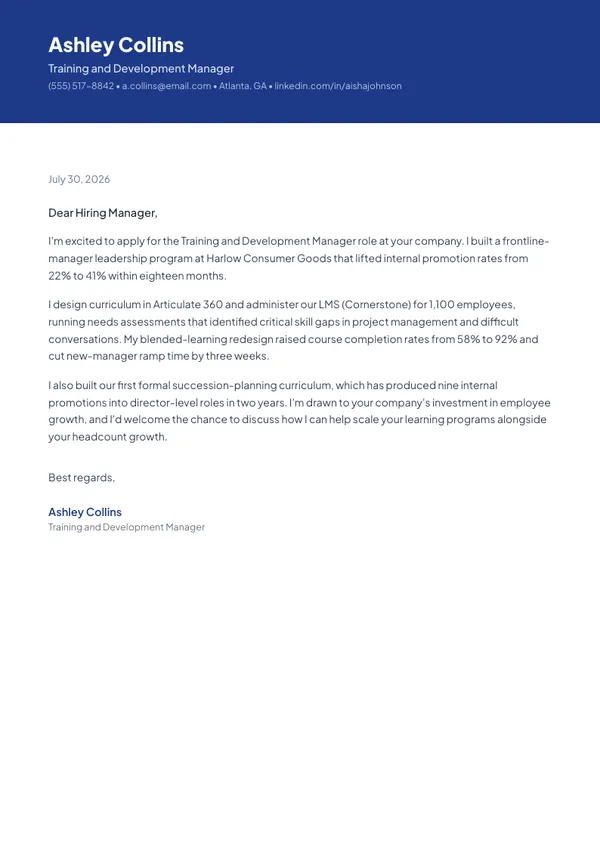
Training and Development Manager
Executive template
View example →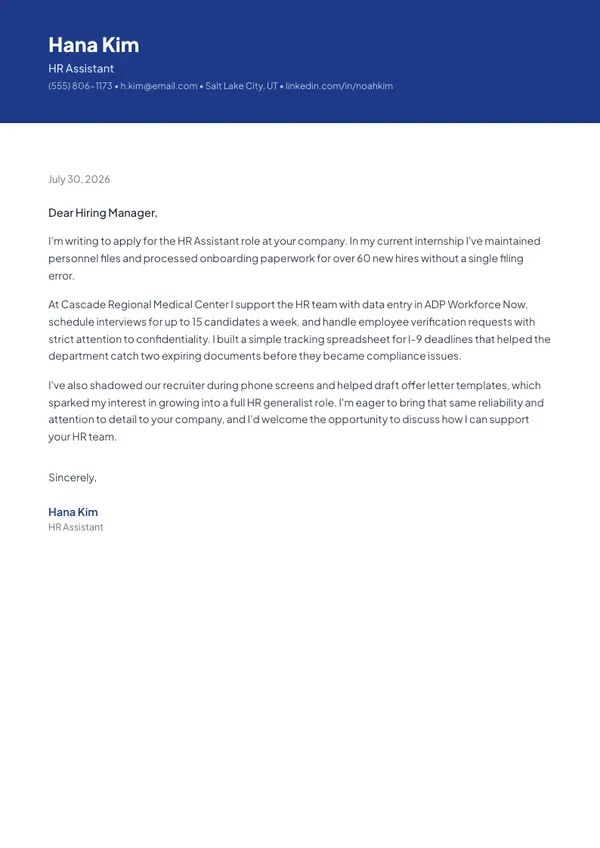
HR Assistant
Executive template
View example →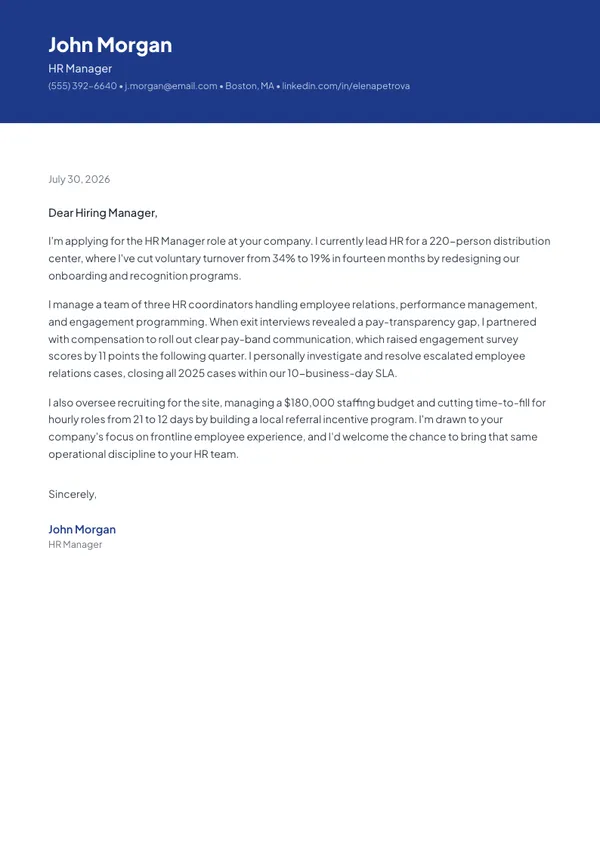
HR Manager
Executive template
View example →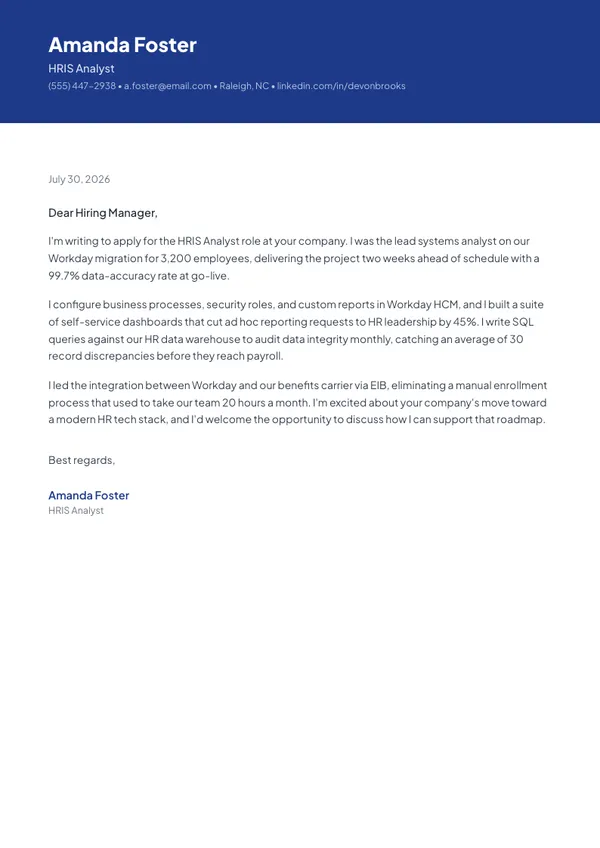
HRIS Analyst
Executive template
View example →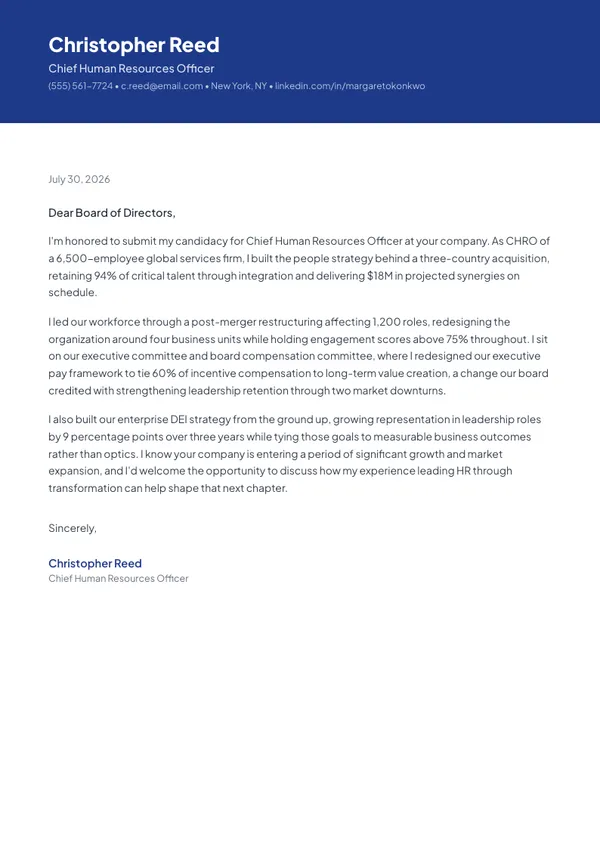
Chief Human Resources Officer
Executive template
View example →What a hr & recruiting cover letter has to prove
You know your numbers cold
Recruiters: reqs carried, hires per quarter, time-to-fill against benchmark, offer-accept rate. HR: headcount supported, retention or attrition change, ER cases closed. These are the first things another HR professional looks for.
You have run the systems
Workday, Greenhouse, Lever, BambooHR, SAP SuccessFactors, naukri and LinkedIn Recruiter for sourcing roles. ATS and HRIS fluency is a hard screen in most postings — name yours in the body, not just the resume.
You can hold a confidence
One line demonstrating discretion — ER investigations handled, sensitive exits managed, compensation cycles run — signals the judgment that separates HR professionals from HR administrators.
You know the law you operate under
Name the compliance surface you have actually worked: labour law filings, POSH committee work, EEO reporting, works councils, payroll compliance. Jurisdiction-specific experience is often the deciding factor between equal candidates.
You have built or fixed a process
An onboarding flow that cut ramp time, an interview loop that raised offer-accept, a policy rollout that actually got adopted. Process ownership is what promotes coordinators to generalists and generalists to HRBPs.
You have read the company’s people story
Their growth stage, a recent expansion, their published culture principles, even their Glassdoor pattern — one accurate observation about their people challenges converts the letter from generic to consultative.
How to structure it
- 1
Open with the role and your defining metric
Position, then the number that best summarises you: "42 technical hires last year at a 91% offer-accept rate". You are writing to someone who thinks in exactly these terms.
- 2
Prove the core loop of the specific role
Recruiting: sourcing to close, with volumes and niches. Generalist: the employee lifecycle you own. HRBP: a business problem you solved through people levers. Match the paragraph to the posting’s first three bullet points.
- 3
Show systems and compliance in one tight paragraph
The HRIS/ATS you run, the compliance work you have owned, one process you improved with its result. Three sentences maximum — density here reads as competence.
- 4
Close with their context
Tie your experience to their stage — scaling, consolidating, entering a market — and ask for the conversation plainly. HR readers notice, and discount, hedged closings.
Questions people ask
What does a recruiter look for in a recruiter’s cover letter?
Proof you have carried comparable load in a comparable market: how many requisitions at once, what niches (tech, sales, volume, executive), which sourcing channels, and your time-to-fill and offer-accept rates. Plus the ATS you work in. A recruiter reading another recruiter’s letter is pattern-matching for someone who can take requisitions off their desk in week one — make that calculation easy.
How do I quantify HR work that isn’t recruiting?
Scope plus delta. Scope: headcount supported, sites covered, programs owned. Delta: attrition down from X% to Y%, onboarding ramp cut by weeks, engagement scores up, ER resolution time halved, audit findings closed. Even policy work quantifies — "rolled out to 800 employees across 3 offices with 95% training completion". If you ran it, there is a number in it.
Should an HR fresher’s letter mention certifications like SHRM or HR analytics courses?
Yes, briefly and concretely — a SHRM-CP, a POSH certification, or an HR analytics course signals seriousness at entry level. But pair every credential with one applied proof: a placement-cell drive you coordinated, an internship where you screened real candidates, a survey you analysed. Credentials open the door; the applied line is what gets remembered.
Is it a red flag to mention confidential situations like investigations?
Only if you give details. The professional move is to name the category and the outcome without the story: "conducted workplace investigations and closed all cases within policy timelines". That demonstrates both the experience and the discretion — describing an actual case, even anonymised, demonstrates the opposite.
How long should an HR cover letter be?
Three to four short paragraphs. HR readers screen at volume and know exactly what a padded letter is doing. Brevity with numbers is itself evidence of the communication judgment the role requires. Every example on this page fits on one page with margin to spare.
Start from one of these hr & recruiting letters
Pick the example closest to your role, open it in the builder, and replace the details with your own.