How to write a cover letter that actually gets read
The structure block by block, the opening line that earns the second paragraph, how to address it when there is no name — plus the India-specific answers generic guides skip: email-body letters, expected CTC, and fresher letters with nothing to list yet.
Do you actually need a cover letter?
The honest answer depends on one thing — what the application form says. Three cases, and only one of them means skip it.
Required field
Write it, and write it for that job. A required cover letter is a filter — the applications that paste a generic paragraph in are the ones it is designed to catch.
Marked optional
Still send one. "Optional" is where the decision actually gets made: when two candidates read the same on paper, the one who explained why this company gets the call. Most applicants skip it, which is exactly why it works.
Explicitly not wanted
Do not attach one. A posting that says "no cover letters" is testing whether you read the instructions, and an unwanted attachment is the wrong first impression to make.
Cover letter format, block by block
Eight blocks, in this order. The middle three are where the letter is won or lost; the rest are conventions worth getting right because getting them wrong is noticed.
Your contact block
Name, phone, email, city, LinkedIn — the same details, in the same font, as the header of your resume. The two documents arriving as an obvious pair is a quiet competence signal, and it costs nothing.
Date and employer details
The date, then the hiring manager or team, company and city. If you cannot find a named person, the department is enough — "Engineering Hiring Team" beats inventing a name you are not sure about.
Salutation
Use a name if you have one: "Dear Ms. Iyer,". If you do not, "Dear Hiring Manager," is the safe modern default. Avoid "To Whom It May Concern" and "Respected Sir/Madam" — both read as a letter written for nobody in particular, which is usually what they are.
Opening paragraph — the hook
Two or three sentences: the role you want, and the single strongest reason you are credible for it. Lead with the proof, not the preamble. "I have led three ERP migrations, the last one for a 400-person manufacturer" opens a letter; "I am writing to apply for the position advertised on your website" wastes the only lines you are certain get read.
Body — the proof
One or two paragraphs picking two or three requirements from the job description and answering each with something you actually did, with a number attached. This is not a prose version of your resume — it is the argument your resume can only imply, told in the order this employer cares about.
Why this company
Two or three sentences that could not be sent to anyone else: their product, their market, a recent launch, the specific problem the role exists to solve. If you could swap the company name and the paragraph still works, it is filler and a recruiter will read it as such.
Closing and call to action
Say what you want — a conversation — and make the next step easy. Confident and brief. Skip "I look forward to hearing from you at your earliest convenience" and skip apologising for your gaps; the letter is not the place to argue against yourself.
Sign-off
"Sincerely," or "Regards," and your full name. A typed name is fine; a scanned signature adds nothing and, in a PDF a parser reads, occasionally subtracts.
Want the blocks already assembled? Every one of our cover letter examples is a complete letter in this structure, and the hook–pitch–close formula walks through the three paragraphs in detail. For the layout itself — sender block, date, subject line, filled samples and a Word skeleton — see the cover letter format page.
Or start from your industry — each hub explains what letters in that field must prove: customer service, marketing & sales, consulting & business, HR & recruiting, nursing & healthcare and restaurant & hospitality.
Length, formatting and the file itself
250 to 400 words. Three or four short paragraphs, half to three-quarters of a page, with white space between them. Nobody has been rejected for a letter that was too short. A full page of unbroken text gets skimmed to the first line and abandoned — which means the two sentences you worked hardest on are the only two that ever mattered.
Match your resume. Same font, same header, same accent colour, single column, 11–12pt, standard margins. The two documents should look like they came from one person, because a recruiter opens them thirty seconds apart.
Send a PDF named Firstname-Lastname-Cover-Letter.pdf. The layout arrives intact, the file is findable in a folder of two hundred attachments, and every modern system reads text-based PDFs. Use DOCX only when a portal specifically demands it, and never send an image or a scan — to a parser, those are blank pages.
When the cover letter is the email
A large share of applications in India never touch a portal — you email a recruiter, a consultancy or an HR alias directly. In that case the cover letter is the body of the email, not a second attachment. Attaching it as a separate file is how it goes unopened.
Write a subject line that survives a full inbox — role, your name, and the requisition ID if the posting gave one: “Senior Data Analyst — Ananya Rao — REQ-4471”. Then keep the body to about 150 words: your strongest proof point, two requirements answered, one line on why this company, and a close. Attach the resume as a PDF and say so in one plain sentence.
If — and only if — the posting asks for current CTC, expected CTC or notice period, add them as a single line at the very end, after your case is made. Leading with salary numbers anchors the conversation before you have any leverage in it, and volunteering them when nobody asked does the same thing for free.
Writing a cover letter as a fresher
The fresher letter has one job the experienced letter does not: proving you can already do something, when your resume mostly proves you have studied it. That is a writing problem, not an experience problem.
- Open with a project, internship or competition result — not with the fact that you are a fresher. The reader can see your graduation year.
- Pick two requirements from the job description and answer each with coursework, a project or an internship, with a number where one exists ("built a Django app used by 200 students during placement season").
- Name the company specifically: their product, a recent launch, why that team. Freshers who do this are rare enough that it is remembered.
- Keep it to 200–300 words. A long letter from a short resume reads as padding, and it will be read that way.
See it assembled in the fresher cover letter example, and pair it with the resume writing guide so both documents make the same argument.
Five lines to cut on sight
Each of these appears in a large fraction of the letters a recruiter opens, which is exactly why none of them earn their space.
I am writing to apply for the position of…
Open with your strongest proof point instead. The subject line and the attachment already say which job this is.
Kindly find attached my resume for your kind perusal.
Say "My resume is attached" — or nothing. This phrase dates a letter by twenty years.
I am a hard-working team player with excellent communication skills.
Unfalsifiable, so it carries no information. Replace with one thing you did and what it produced.
I would be a great fit for your esteemed organisation.
Name the company and one specific thing about it, or cut the sentence entirely.
Though I lack experience in this field…
Never argue the case against yourself. Lead with the transferable evidence and let the reader do their own subtraction.
Start from a matching template
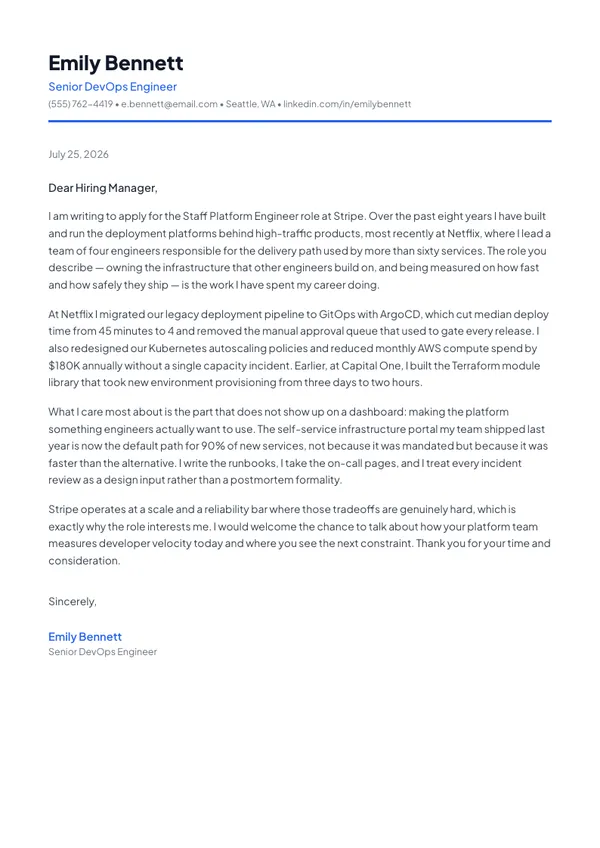
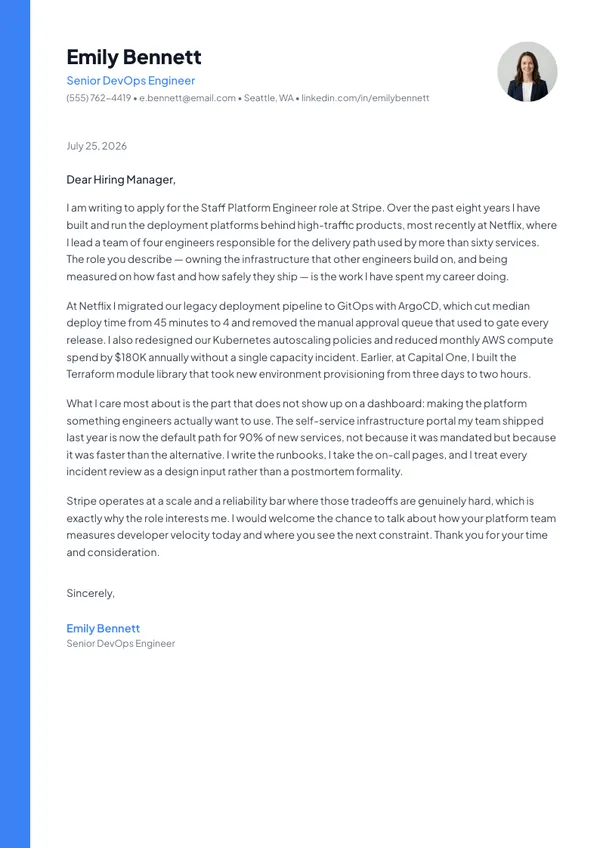
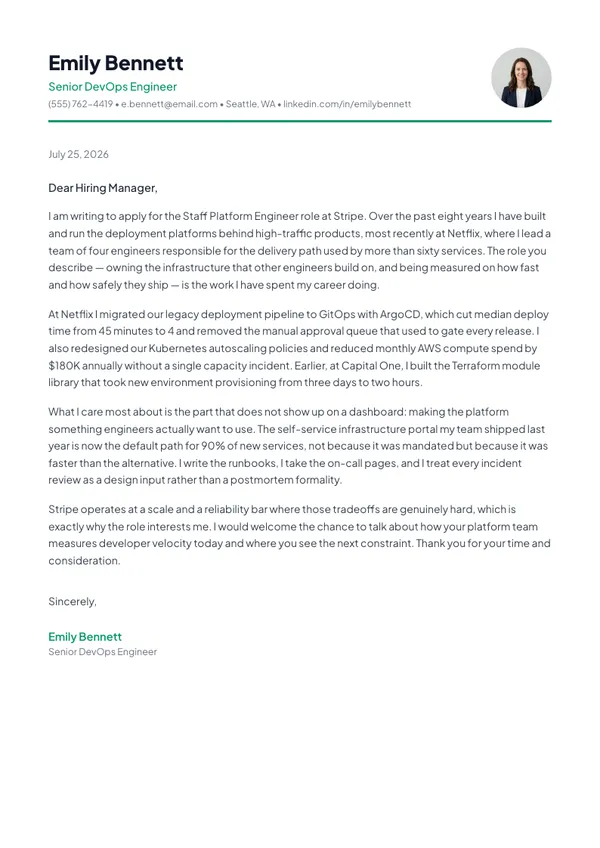
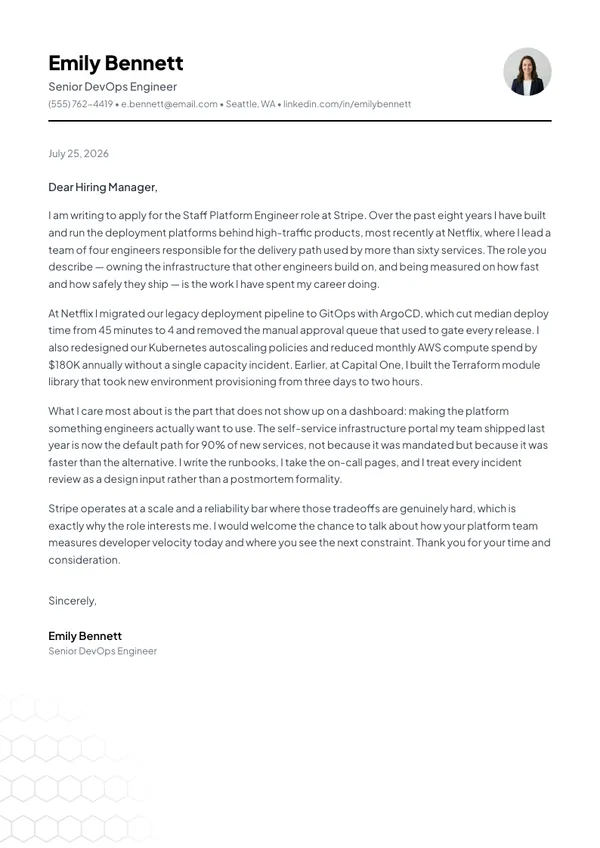
View all 8 templates →Each design pairs with a resume template, so the two documents arrive looking like one application.
See it done for your job title
155 complete cover letter examples, each with the keywords, structure and opening line that role is actually screened on — open any of them straight into the builder.
Write it, then make the resume match
The letter makes the argument; the resume has to survive the software first. Draft your letter in the cover letter builder, then run the resume you are sending with it through the free ATS resume checker to see your match score and missing keywords before a recruiter does.
Write your cover letter free