Resume Formats: Chronological vs Functional vs Hybrid
By Jyoti Sinha, Talent Acquisition Specialist at Leinex Consulting · August 8, 2026 (updated September 19, 2026) · 7 min read
Search for 'resume formats' and you will find the same three answers everywhere: chronological, functional, and hybrid. What most guides will not tell you is that this is not really a three-way choice. One format wins for the overwhelming majority of job seekers, one is genuinely useful in specific situations, and one actively damages your chances in 2026. Here is the honest breakdown.
The Three Formats at a Glance
- Reverse-chronological: your work history, newest first, front and centre. The default — and what recruiters and ATS software are built to expect.
- Functional (skills-based): skills grouped by theme at the top, with work history reduced to a bare list. Designed to de-emphasize gaps and job changes — and recruiters know it.
- Hybrid (combination): a substantial skills or competencies section up top, followed by a full reverse-chronological history. The career changer's format.
Reverse-Chronological: The Default for a Reason
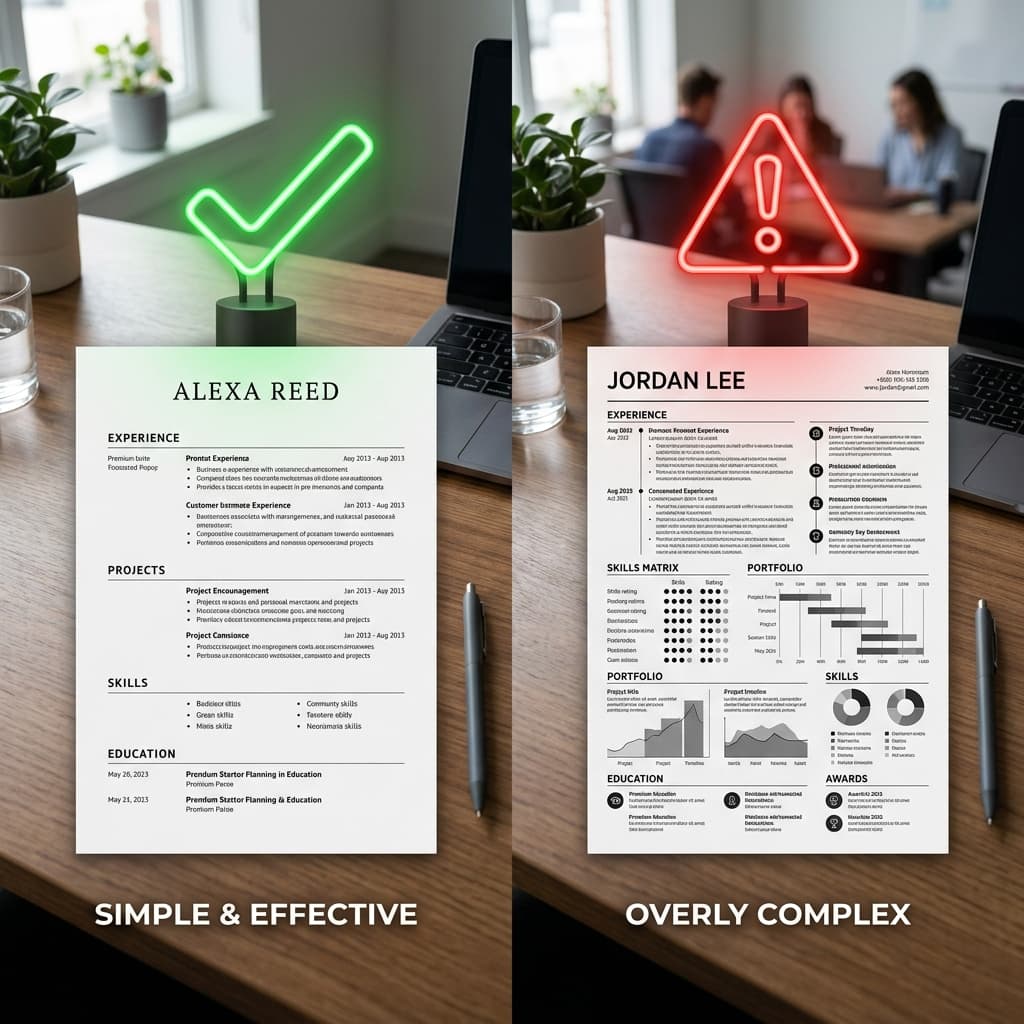
The reverse-chronological format tells your story the way recruiters want to hear it: what you are doing now, what you did before that, and how you have progressed. It answers the reader's core questions — where, what, how long, how senior — in a single glance down the page.
Structure
- Contact information: name, phone, email, LinkedIn URL, city
- Professional summary: 2–3 sentences tailored to the target role
- Work experience: newest role first, each with job title, company, dates, and 4–6 achievement bullets
- Education: degree, institution, year
- Skills: a clean list of hard skills and tools
- Optional extras: certifications, projects, volunteer work
Who should use it
- Anyone with a steady work history in one field — short gaps included; those are normal
- Professionals with visible progression: promotions, growing scope, bigger teams
- Anyone applying through company career sites, job portals, or Naukri, where parsers are tuned for exactly this structure
Who should think twice
Career changers whose most recent job titles point in the wrong direction, and people returning from multi-year breaks, may find that a pure reverse-chronological resume leads with their weakest material. For them, the hybrid format below usually works far better than abandoning chronology altogether.
Functional: The Format Recruiters Distrust
The functional resume flips the structure. Skills are grouped into thematic clusters — 'Leadership', 'Project Management', 'Communication' — with achievement snippets under each, while actual employment history is compressed into a bare list of employers and titles, often without dates. The sales pitch is that it showcases what you can do rather than where you have been.
Structure
- Contact information
- Summary or objective
- Skill clusters: 3–4 thematic groups, each with bullets describing accomplishments, detached from any specific employer
- Brief work history: employer names and titles, minimal or no dates
- Education
Why recruiters are suspicious of it
Recruiters read hundreds of resumes a week, and they have learned what a functional format usually signals: something is being hidden. Long gaps, rapid job hopping, thin experience, a step down in title. The moment an achievement cannot be connected to a specific employer and time period, every claim on the page becomes unverifiable — 'led a team through a complex migration' means very different things at a ten-person startup in 2015 versus at enterprise scale last year. Many recruiters will tell you openly that a functional resume triggers more scrutiny, not less — the exact opposite of what it is meant to achieve.
Why it parses terribly in ATS
ATS parsers are built around one core expectation: work experience arrives as repeating units of job title, employer, date range, and description. The functional format breaks every part of that contract. Achievements detached from employers cannot be mapped to any role. Missing dates make experience calculations fail, so the system may credit you with almost no tenure at all. And the bare employer list at the bottom parses as a work history with no content. The result is a candidate profile that looks nearly empty in the recruiter's database — your carefully written skill clusters often land in an 'other' field that nobody searches.
Is it ever the right choice?
Rarely. If you are handing a resume directly to a human — a walk-in interview, a small local employer, a personal referral where no ATS is involved — and your history genuinely cannot be framed any other way, a functional resume can occasionally work. For any online application, use the hybrid format instead. It solves the same problems without raising the same red flags.
Hybrid: The Career Changer's Format
The hybrid (or combination) format keeps the full reverse-chronological work history but adds a substantial skills-focused section at the top. You get the best of both worlds: the front of the resume reframes your story around transferable skills, while the timeline underneath keeps everything verifiable for recruiters and parseable for machines.
Structure
- Contact information
- Professional summary: explicitly framing the transition, e.g. 'Operations manager transitioning into data analytics...'
- Skills summary or core competencies: your transferable and newly acquired skills, optionally with 2–3 headline achievements
- Work experience: full reverse-chronological entries with titles, employers, dates, and bullets angled toward the target role
- Projects and certifications: essential for career changers proving new skills
- Education
Who it works for
- Career changers: the top section leads with skills relevant to the new field before the reader reaches mismatched job titles
- Returners: someone re-entering the workforce after caregiving or a sabbatical can lead with capabilities while the dated history stays honest below
- Freshers with strong projects: recent graduates — a huge share of India's applicant pool — can lead with skills and projects when internship history is thin
- Deep specialists: technical experts whose tool and domain inventory is itself a major selling point
One warning: the hybrid front section adds length. Keep the skills summary tight — a third of a page is plenty — or the resume balloons past two pages and the reader never reaches your work history.
Why Reverse-Chronological Wins for Most People
- It is what every ATS is engineered to parse — clean title, company, and date units extract reliably and score properly.
- It is what recruiters read fastest. Familiarity means the six-second skim goes to your content, not to decoding your layout.
- It makes progression visible — promotions and growing scope tell a story no skills list can.
- It is verifiable — every claim is anchored to an employer and a time period, which builds trust.
- It is what Indian job portals expect too — Naukri's profile and resume parsing are built around the same newest-first structure.
Unless you have a specific structural problem that the hybrid format solves, reverse-chronological should be your default. And even when you do have that problem, the answer is hybrid — not functional.
Format FAQs
I have a six-month employment gap. Do I need a functional resume?
No. Short gaps are normal, and most recruiters barely react to them anymore. Stay reverse-chronological; if a gap runs longer than a year, add a one-line explanation — further study, caregiving, health, relocation. A brief honest line defuses far more suspicion than any format trick ever will.
Which format is best for freshers?
A modified reverse-chronological with education first: contact details, summary, education, projects, internships, skills — the fresher resume format page has it as a free Word download. Since freshers have little work history, projects and internships do the heavy lifting — but the newest-first logic still applies inside every section.
Does the format itself change my ATS score?
Indirectly, but powerfully. Your score reflects what the parser successfully extracts, and reverse-chronological structures extract cleanly while functional ones lose data. Same person, same skills — very different machine-readable profile. Run your resume through our free ATS Resume Checker to see exactly what a parser pulls out of yours.
Can I use different formats for different applications?
Yes, and you should think of it that way. A hybrid resume for a career-change application and a reverse-chronological one for a same-field application can happily coexist. Just keep the underlying facts — titles, employers, dates — identical everywhere, including on LinkedIn and Naukri, because recruiters cross-check.
Are 'chronological' and 'reverse-chronological' the same thing?
In practice, yes. When recruiters or guides say 'chronological resume', they almost always mean reverse-chronological — newest role first. Nobody wants to read your career in strict historical order starting from your first internship, and no modern template is built that way.
Pick the Boring Format, Win on Content
Resume format is a solved problem: reverse-chronological for most people, hybrid for career changers and returners, functional for almost no one. The resume format guide gives you the section order and downloadable layouts for each. The real differentiation happens inside the structure — the strength of your bullets, the match of your keywords, the clarity of your story. Pick the boring format, then spend your energy where it actually pays. Our free resume builder at ATS First gives you clean reverse-chronological and hybrid templates that parse correctly out of the box, so the format question is settled before you type a single word.
Check your resume's ATS score — free
Upload your resume + paste any job description. Get your score in 60 seconds.
Analyze My Resume →