Design & Creative Cover Letter Examples
Design hiring managers open the portfolio first and the cover letter second — which makes the letter the place to explain the work, not describe yourself. These examples cover UX, UI and product designers, art directors, graphic and motion designers, interior and fashion designers, video editors and photographers, and each is a complete letter you can open in the builder and edit.
A creative cover letter fails in one of two ways: it is a list of software, or it is a personality statement. Neither tells a creative director what happens when you are given a brief. The letters that get calls point at a specific piece of work, say what the problem was, what you decided and what it did — conversion, engagement, a client retained, a launch shipped — and then link the portfolio so the reader can see it in thirty seconds.
Build My Cover Letter Free10 Creative & Design Cover Letter Examples
Every letter below is complete and specific to its role. Open any of them in the builder and edit each line — nothing here is a placeholder.
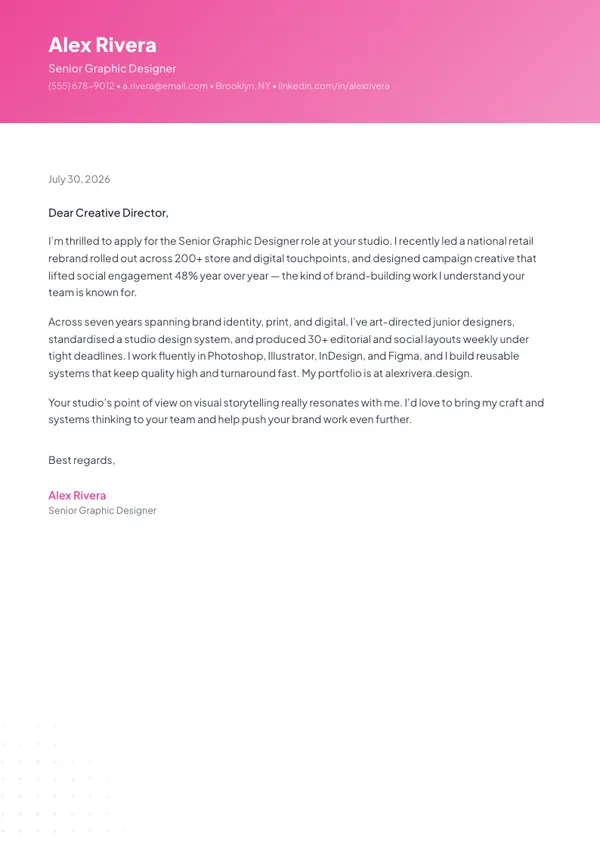
Graphic Designer
Creative Gradient template
View example →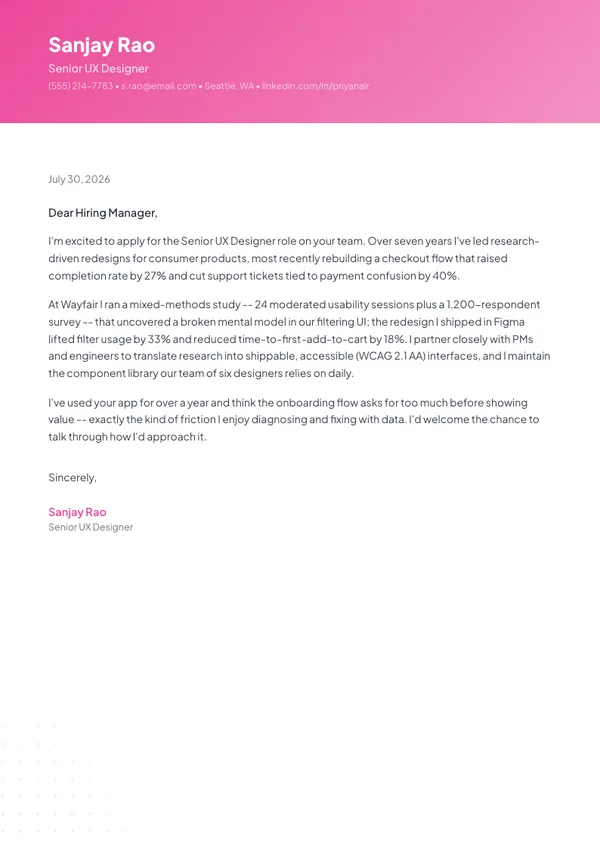
UX Designer
Creative Gradient template
View example →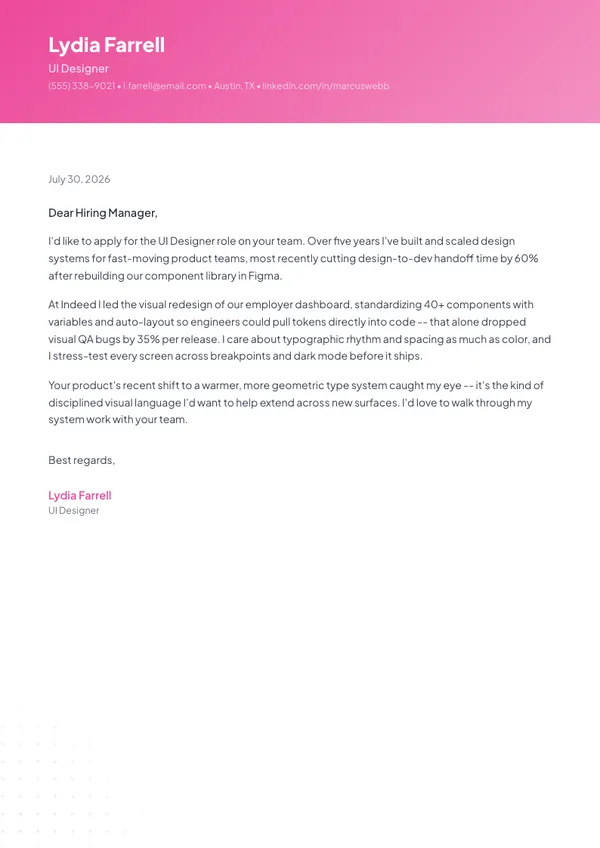
UI Designer
Creative Gradient template
View example →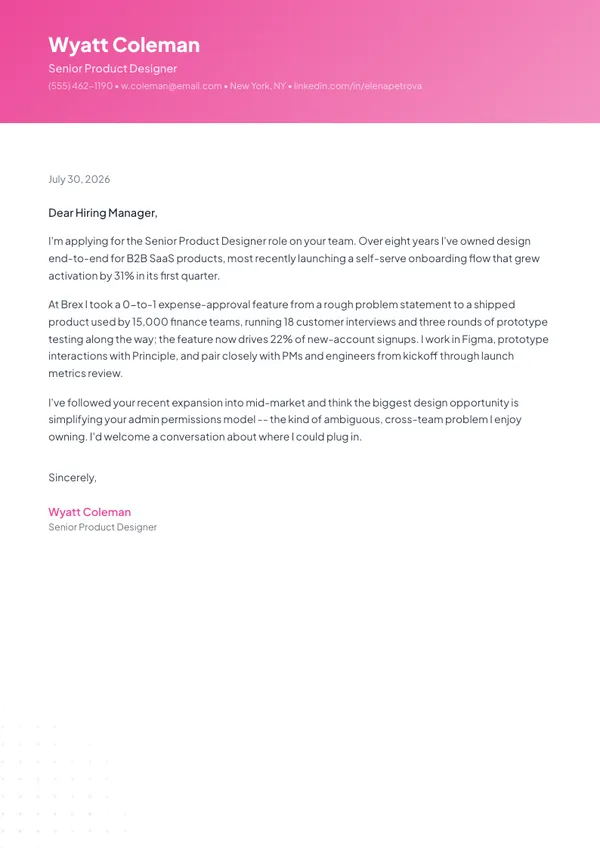
Product Designer
Creative Gradient template
View example →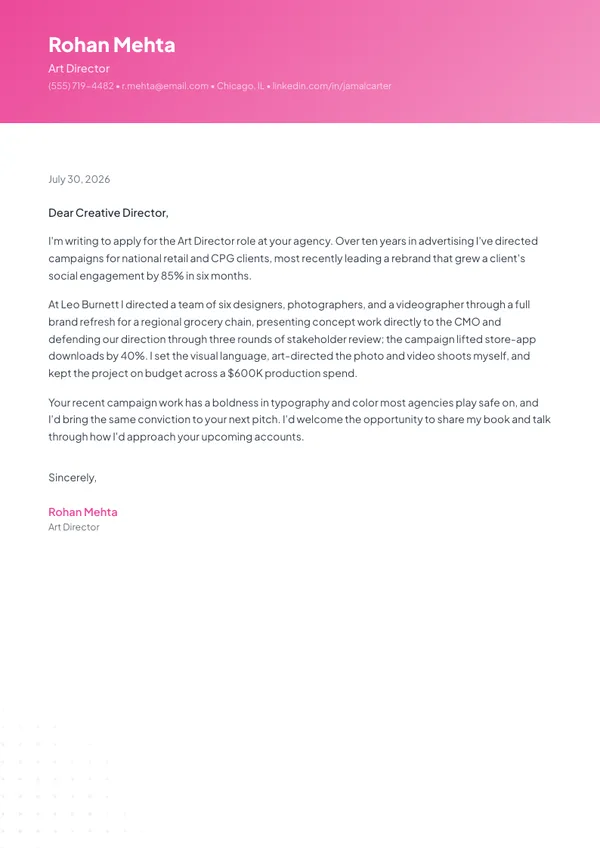
Art Director
Creative Gradient template
View example →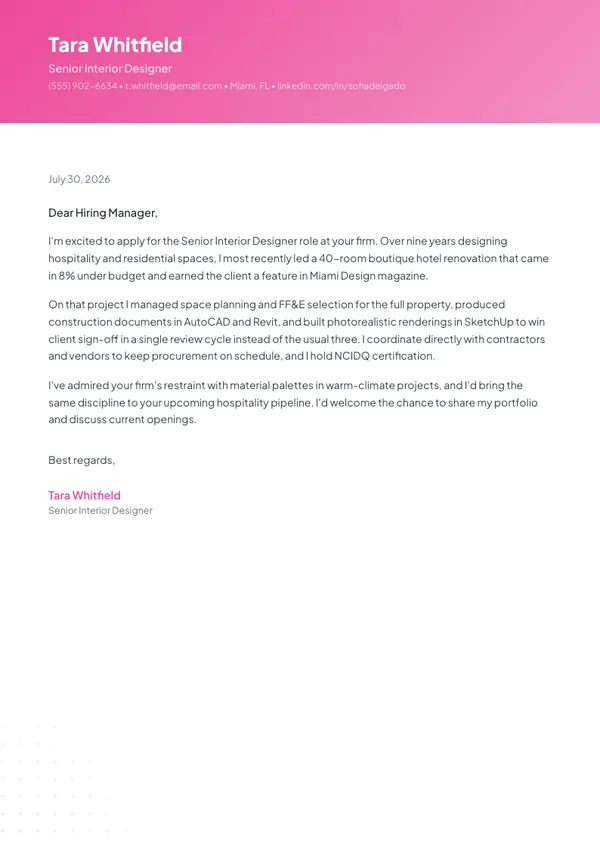
Interior Designer
Creative Gradient template
View example →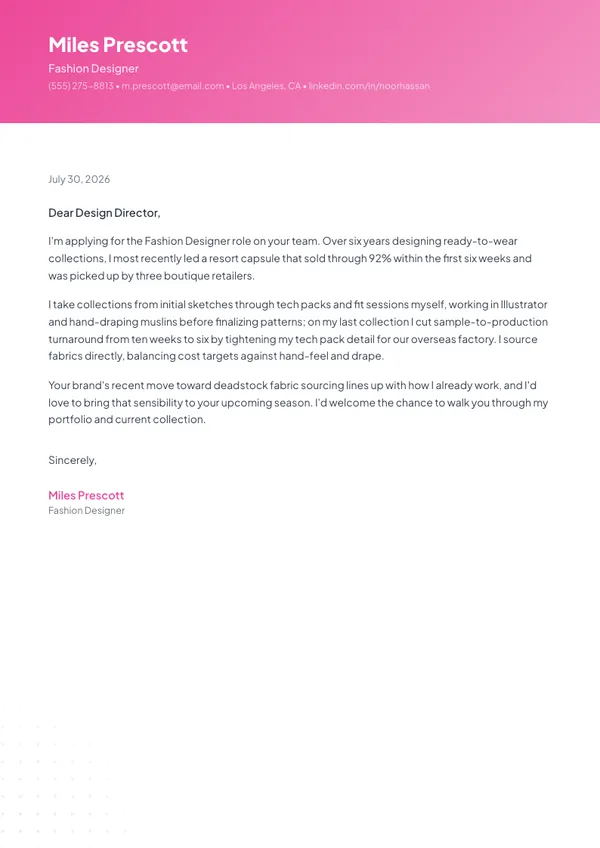
Fashion Designer
Creative Gradient template
View example →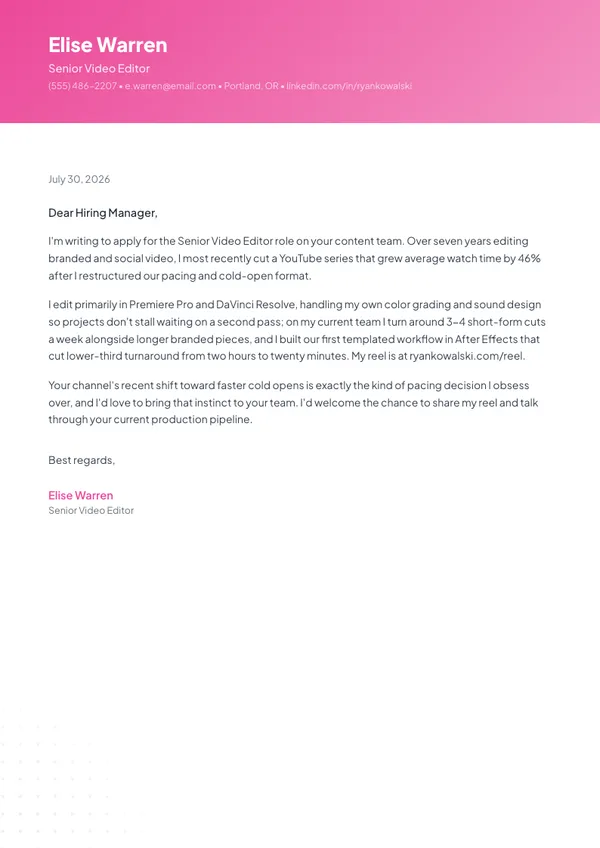
Video Editor
Creative Gradient template
View example →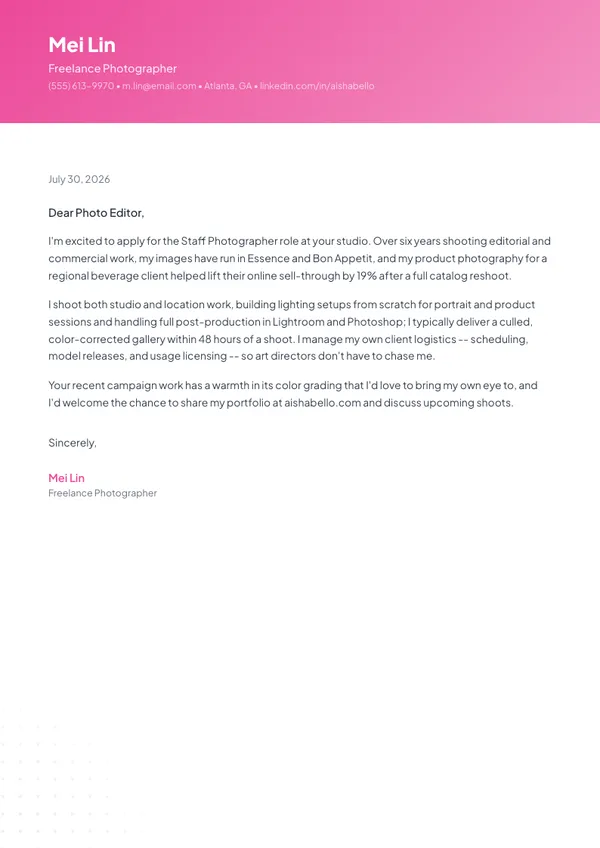
Photographer
Creative Gradient template
View example →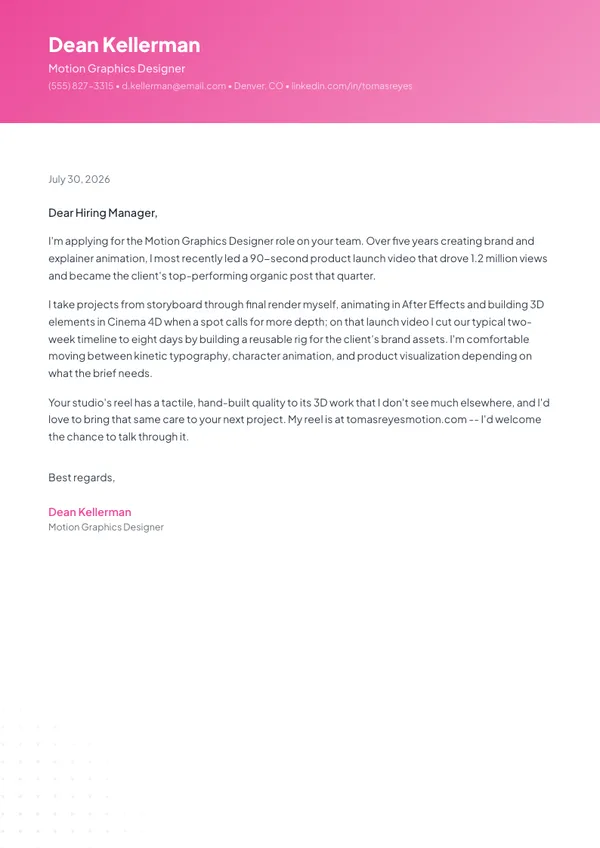
Motion Graphics Designer
Creative Gradient template
View example →What a creative & design cover letter has to prove
Your work had an effect you can name
A redesign that lifted conversion, a campaign that hit its numbers, a brand system a client kept for years, a film that met its view target. Design is judged on outcome in hiring rooms even when it is judged on craft in studios.
You can point at the piece
Link the portfolio and name one or two projects in it by name. "See the onboarding case study on my site" turns the letter into a guided tour rather than a claim.
You work inside a process, with other people
Research you ran, developers you handed off to, a client you presented to, a brief you pushed back on. Studios hire for how you work as much as for what you make.
You know the tools and the constraints they use
Figma, Adobe, After Effects, Premiere, CAD, whatever the posting lists — and the constraints: design systems, accessibility, brand guidelines, print specs, frame rates. Constraints are where amateurs and professionals separate.
You have handled the volume and pace of the job
Assets per week, campaigns per quarter, edits per day, clients in parallel. Agencies especially hire for throughput; state yours.
You have looked at their work
One accurate sentence about a recent project of theirs, a product surface, a campaign or a brand choice. Creative teams notice immediately when a letter could have gone to anyone.
How to structure it
- 1
Open with the role and the one project to look at
"I am applying for the Product Designer role. The checkout redesign in my portfolio — 18% fewer abandoned carts after launch — is the closest thing to the work described in your posting." Role, evidence, link.
- 2
Explain the problem, the decision and the result of that project
Three or four sentences. What the brief was, what you found or chose, what changed. Written like a case study summary, not a job description.
- 3
Show the collaboration and the craft range
Who you worked with, how you handed off, a second project that shows a different skill. Prove you are not a one-style designer without listing every tool you have opened.
- 4
Close on their work and the next step
One specific observation about something they shipped, then an offer — a portfolio walkthrough, a design exercise, availability.
Questions people ask
Do design teams read cover letters or just the portfolio?
The portfolio decides whether you are considered; the letter often decides whether you are called first. Creative directors use the letter to check three things the portfolio cannot show: whether you can explain your decisions in writing, whether you understood the brief in their posting, and whether you looked at their work. A letter that does those three things in under a page is rare enough to move you up the list.
Should I attach work samples or just link the portfolio?
Link it, and name the specific project to open. Attachments get stripped by applicant tracking systems and inflate the file, and a link the reader can follow in one click is faster for everyone. If the posting asks for a PDF portfolio, send one as a separate file and still put the link in the letter. Make sure the named project is the first thing they see when they land.
How do I write a creative cover letter with no professional experience?
Treat your best self-initiated or student project as the case study: the brief you set yourself, the constraints, the decisions and any result — even a class outcome, a competition placing or engagement numbers on a published piece. Then show process: research, iteration, critique you acted on. Studios hire juniors on thinking and taste; a well-explained personal project demonstrates both better than a list of coursework.
How much personality belongs in a design cover letter?
Enough to sound like a person, not enough to replace evidence. Voice comes through in how you describe a decision, not in adjectives about yourself. A letter can be warm and specific at the same time; the ones that fail are those where the personality is the content. If a sentence could be deleted without removing a fact about your work, delete it.
Is the same letter fine for an agency and an in-house team?
Change the emphasis. Agencies hire for pace, range and client handling — campaigns per quarter, brands worked across, presenting to clients. In-house teams hire for depth in one product, design-system discipline and cross-functional work with product and engineering. The project you lead with and the collaboration you describe should match. Start from the example for the specific role below.
Start from one of these creative & design letters
Pick the example closest to your role, open it in the builder, and replace the details with your own.