Science & Research Cover Letter Examples
Scientific cover letters are read by people who will judge them as they judge an abstract: for method, result and relevance. These examples cover research scientists and associates, laboratory technicians, clinical research coordinators, molecular biologists, microbiologists, analytical chemists, environmental scientists, epidemiologists and postdoctoral fellows — each a complete letter you can open in the builder and edit.
The mistake in most science cover letters is writing them like a personal statement. A principal investigator or lab manager wants to know which techniques you can run unsupervised, what you have produced — assays, samples, datasets, publications, protocols — and why their specific research or facility is where you should do it next. The letters below are written in that order, with the techniques named exactly and the results quantified.
Build My Cover Letter Free10 Science & Research Cover Letter Examples
Every letter below is complete and specific to its role. Open any of them in the builder and edit each line — nothing here is a placeholder.
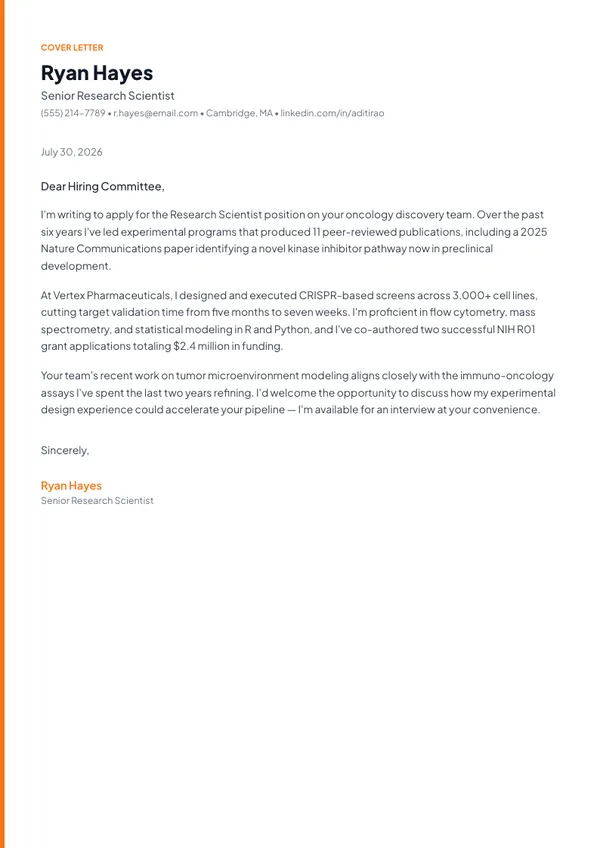
Research Scientist
Timeline template
View example →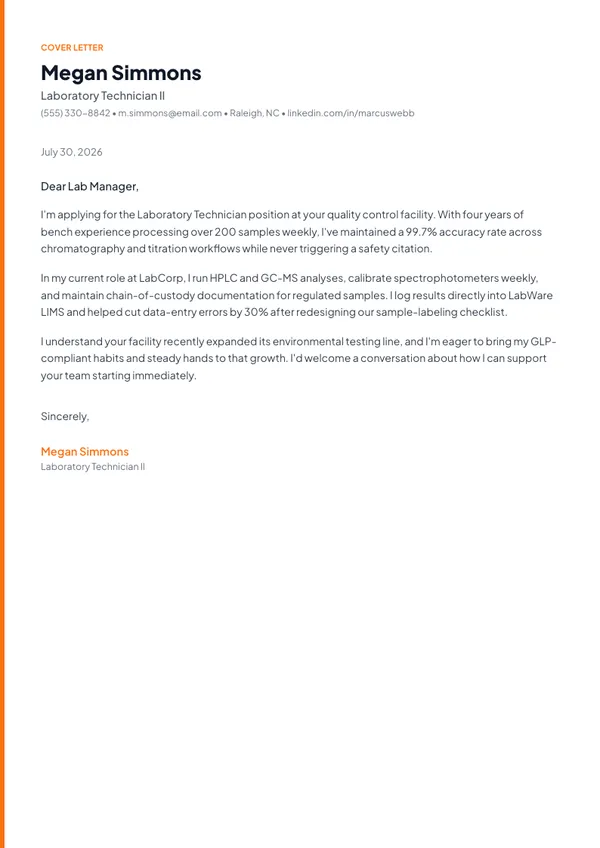
Laboratory Technician
Timeline template
View example →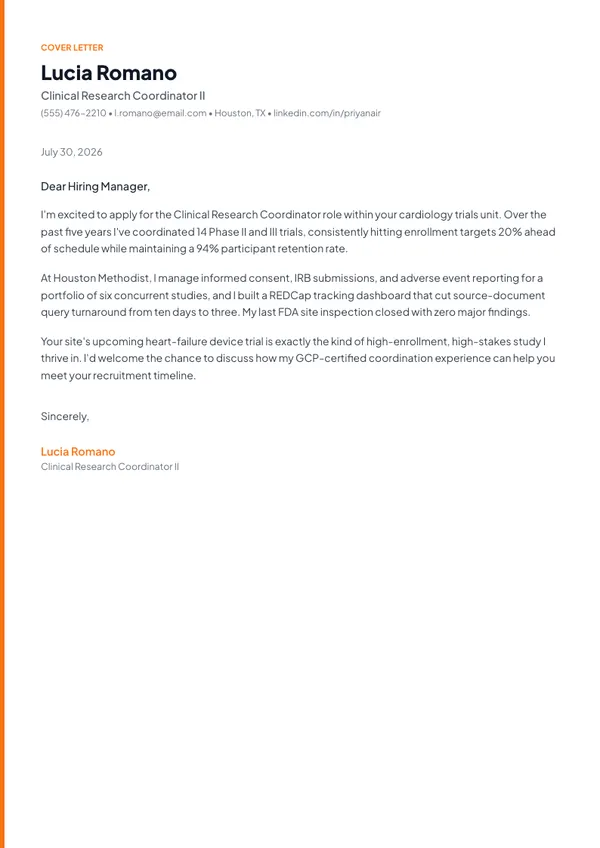
Clinical Research Coordinator
Timeline template
View example →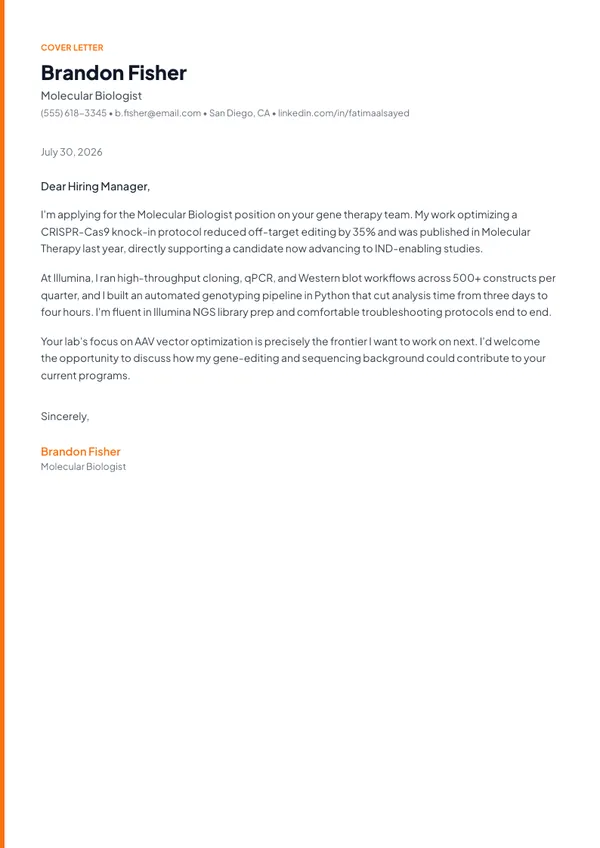
Molecular Biologist
Timeline template
View example →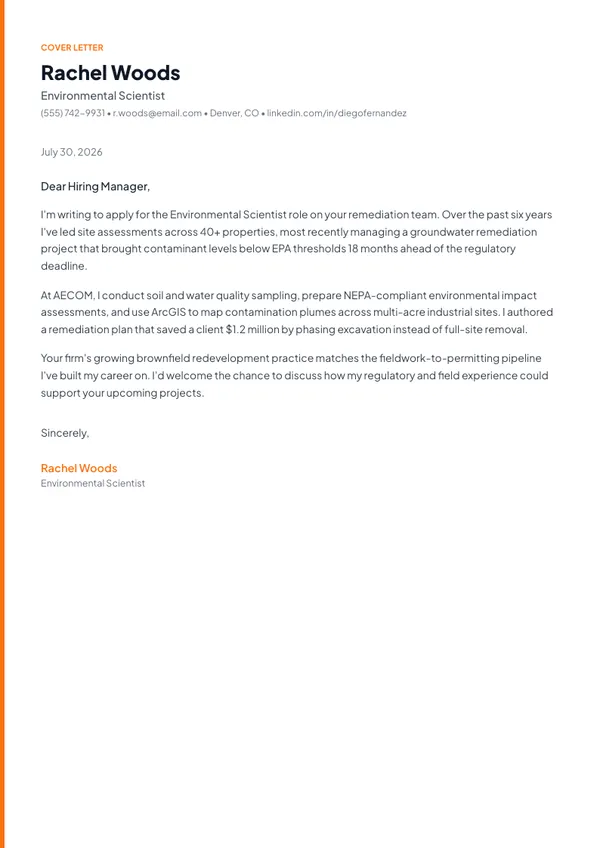
Environmental Scientist
Timeline template
View example →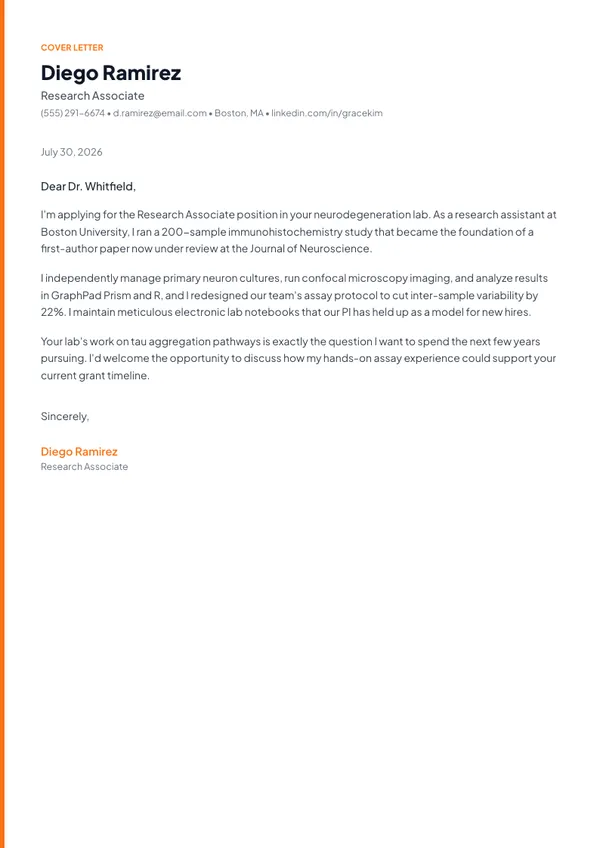
Research Associate
Timeline template
View example →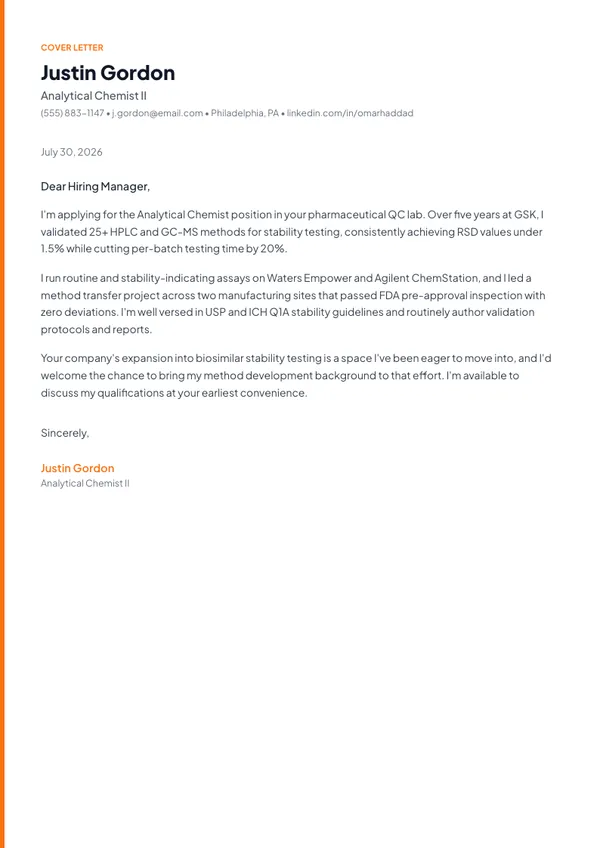
Analytical Chemist
Timeline template
View example →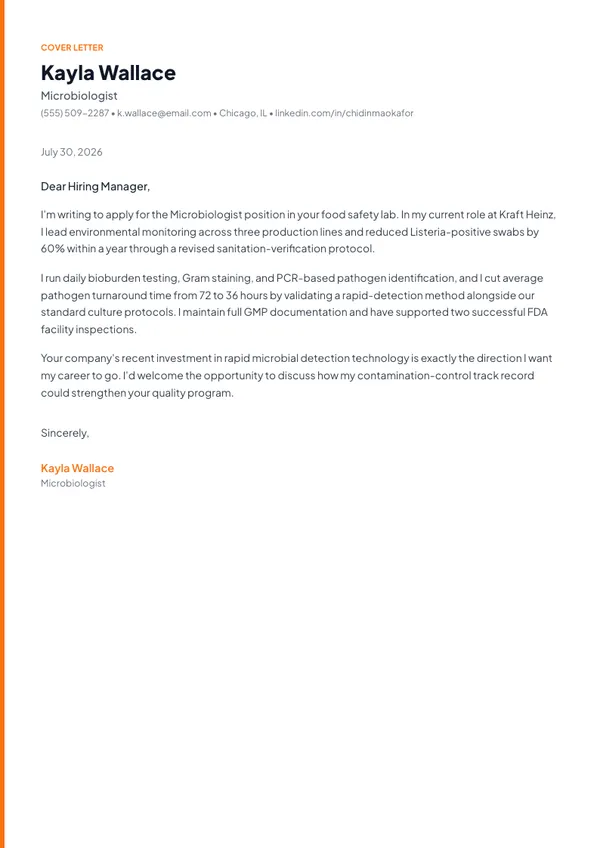
Microbiologist
Timeline template
View example →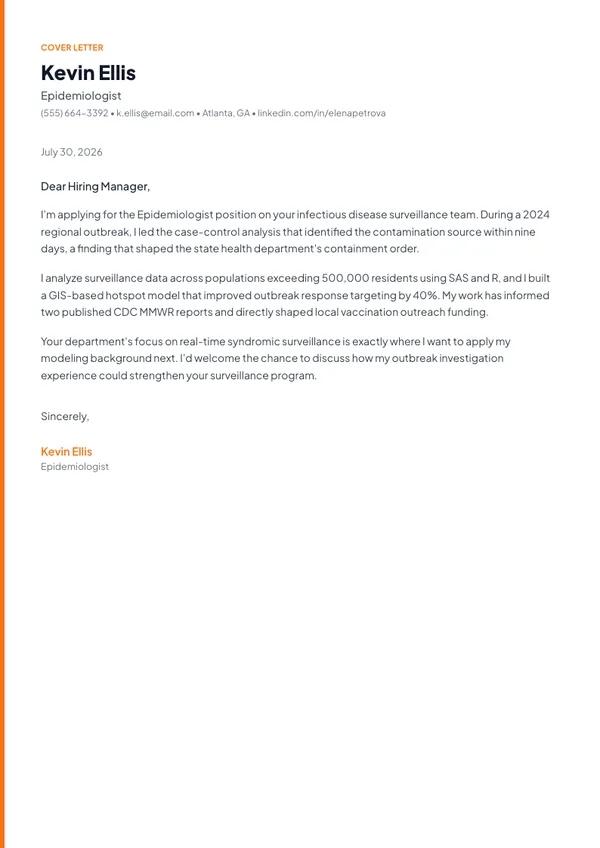
Epidemiologist
Timeline template
View example →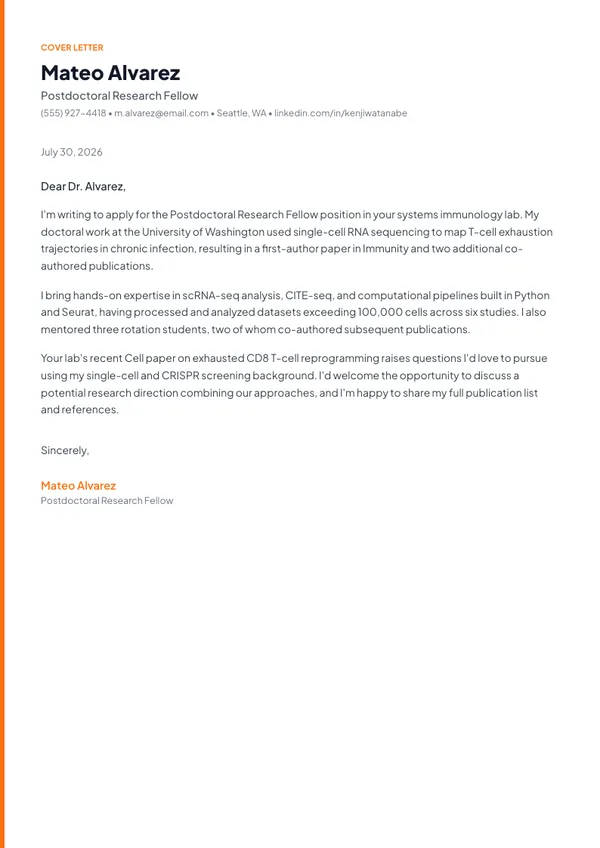
Postdoctoral Research Fellow
Timeline template
View example →What a science & research cover letter has to prove
You run the techniques they use, unsupervised
Name them: PCR and qPCR, cell culture, HPLC, mass spectrometry, flow cytometry, sequencing pipelines, GIS, statistical software. "Experienced in molecular biology" says nothing; "three years of independent qPCR and Western blotting" says everything.
You produced something
Samples processed, assays validated, a protocol you wrote, data you analysed, a publication or poster, a study enrolled on time. Output is the measure; quantify it.
You work to a standard
GLP, GMP, GCP, ISO 17025, IRB or ethics submissions, chain of custody, lab notebooks audited. Regulated environments hire for compliance discipline first.
You solved a problem in the work
A contaminated line, a failed assay you troubleshot, a recruitment shortfall you recovered, a method you adapted. Problem-solving in the lab is what separates a technician from a scientist in the reader’s mind.
You fit their research or their operation
Cite the paper, the study, the programme or the facility capability that drew you. For academic roles this is essential; for industry and clinical roles it is the sentence that shows you read the posting.
You communicate results
Presentations, reports to sponsors, data shared with clinicians, training given to junior staff. Science roles increasingly require explaining the result to someone who did not generate it.
How to structure it
- 1
Open with the role, your qualification and your core techniques
"I am applying for the Research Associate position. I hold an MSc in Microbiology and have four years of independent experience in bacterial culture, qPCR and antimicrobial susceptibility testing under GLP."
- 2
Describe the work and what it produced
The projects or studies, your role, the output — samples, datasets, publications, protocols, enrolment. Two or three sentences a lab manager can verify from the resume.
- 3
Give the problem you solved or the method you improved
What went wrong or what was inefficient, what you did, the result. This is the paragraph that demonstrates scientific judgement rather than technical competence alone.
- 4
Close on their research and your availability
Reference the paper, programme or facility specifically, then start date, visa or relocation status if relevant, and a request to discuss the role.
Questions people ask
Do labs and research groups actually read cover letters?
Yes — in academic and research hiring the cover letter is frequently the primary document, read before the CV, and for postdoctoral and scientist roles it is expected to engage with the group’s research directly. In industry and clinical settings it is read for techniques, regulatory experience and output. In both, a letter that names methods and results precisely is read in full; a personal statement about curiosity is not.
Should I include my publications in the cover letter?
Reference the one or two most relevant, briefly — "first author on a 2025 paper characterising X in Journal Y" — and leave the full list to the CV. For roles where publication is expected (postdoc, research scientist), state your record in numbers: papers, first-authorships, posters. For technician and coordinator roles, protocols written, studies supported and datasets produced matter more than publications.
How do I write a science cover letter as a recent graduate?
Treat your thesis, capstone or research internship as the job: the question, the techniques you ran yourself, the hours or samples, the result, and any presentation or poster. Name the standards you worked under and the software you used. Then explain why this specific lab or company. Graduates are hired on hands-on technique and evidence of independent work; describe both concretely rather than listing modules.
How do I show regulatory or quality experience?
Name the framework and what you did inside it: GLP documentation you maintained, GMP batch records you completed, GCP training and the studies you coordinated under it, an ISO audit you supported, an IRB or ethics submission you drafted. Regulated employers screen for these terms directly, and a sentence showing you operated under them is more persuasive than a claim of attention to detail.
Is the same letter fine for an academic postdoc and an industry scientist role?
No. Academic letters engage with the group’s research questions, your publication record and independence; industry letters emphasise techniques at scale, regulatory compliance, timelines and cross-functional work. Clinical research roles add patient-facing coordination and GCP. The structure is shared; the middle paragraphs should be rewritten for each. Start from the example for the specific role below.
Start from one of these science & research letters
Pick the example closest to your role, open it in the builder, and replace the details with your own.