Engineering Cover Letter Examples
Engineering hiring managers read cover letters for one thing: evidence that you have solved problems like theirs at the scale they work at. These examples cover civil, electrical, network and data engineers, DevOps, site reliability, QA and full-stack developers — each a complete letter you can open in the builder and edit, written around systems built, problems diagnosed and numbers moved.
Engineers are hired by engineers, and engineers distrust adjectives. "Detail-oriented team player with a passion for technology" has never caused an interview; "cut deployment time from 40 minutes to 6 by moving the pipeline to containerised builds" has. The letters below are built from specific systems, tools named exactly as the posting names them, and one quantified result per paragraph — the vocabulary of a design review, not a job ad.
Build My Cover Letter Free10 Engineering Cover Letter Examples
Every letter below is complete and specific to its role. Open any of them in the builder and edit each line — nothing here is a placeholder.
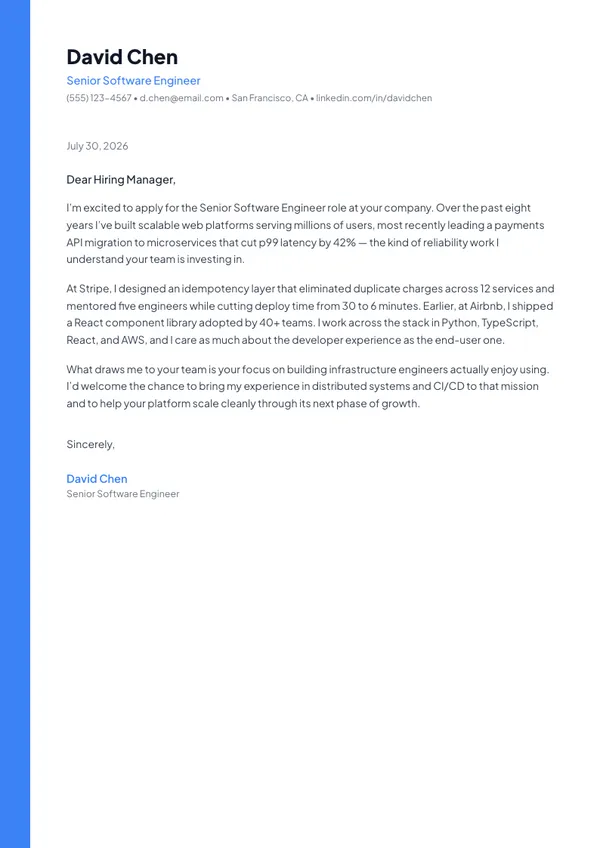
Software Engineer
Modern template
View example →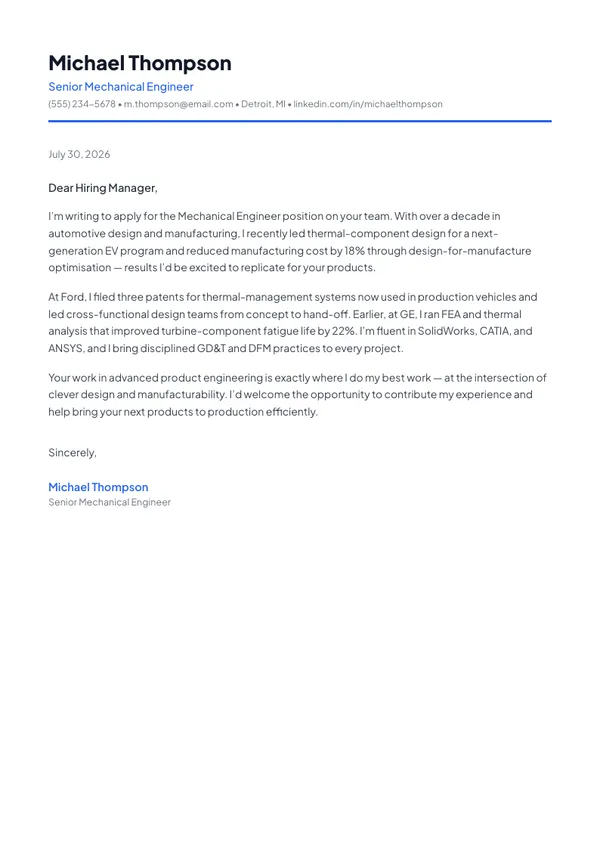
Mechanical Engineer
Basic template
View example →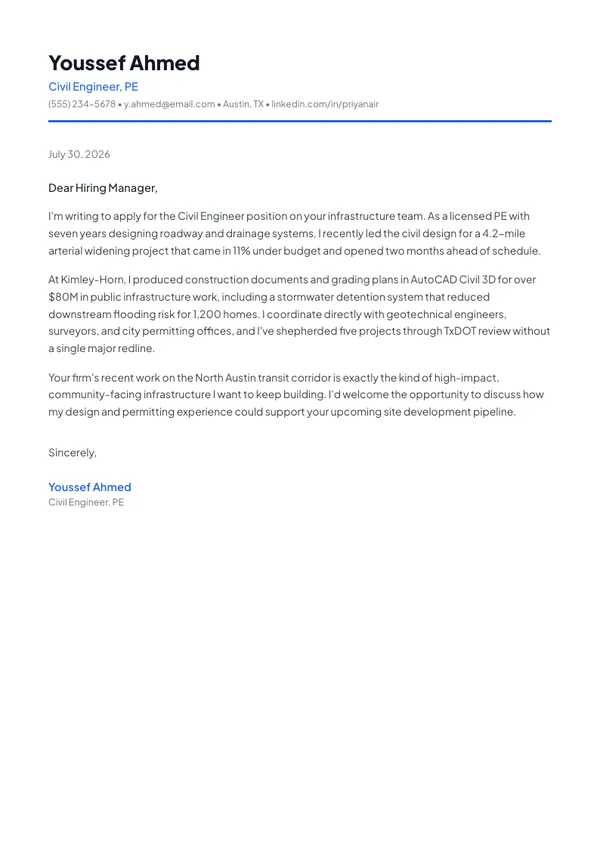
Civil Engineer
Basic template
View example →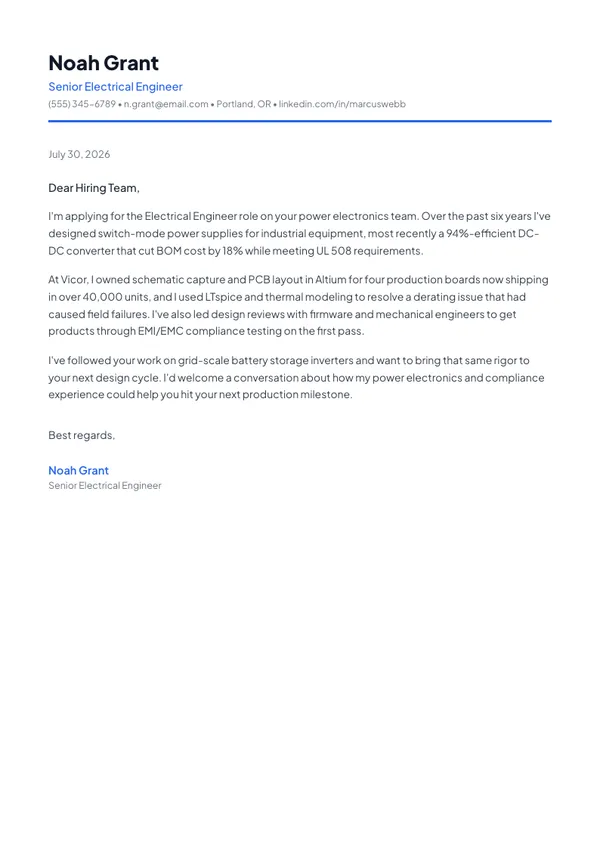
Electrical Engineer
Basic template
View example →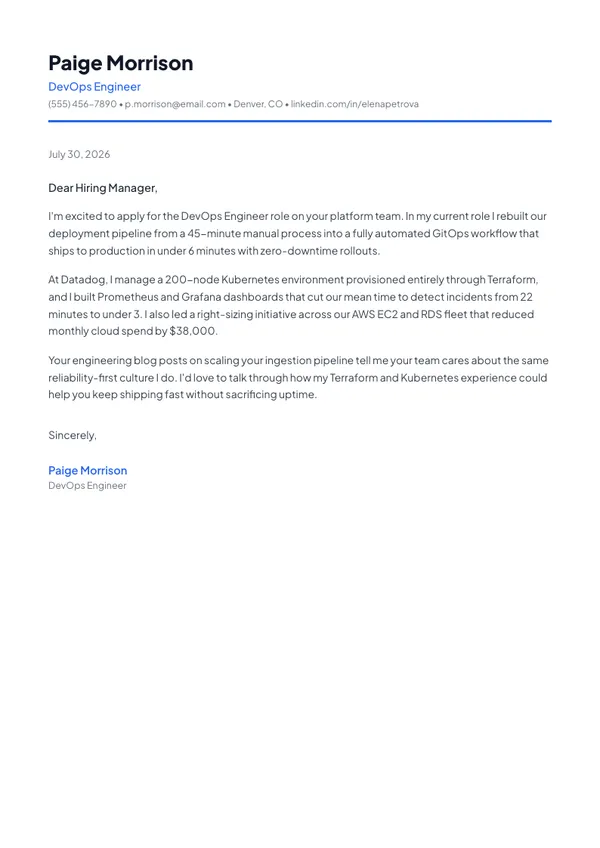
DevOps Engineer
Basic template
View example →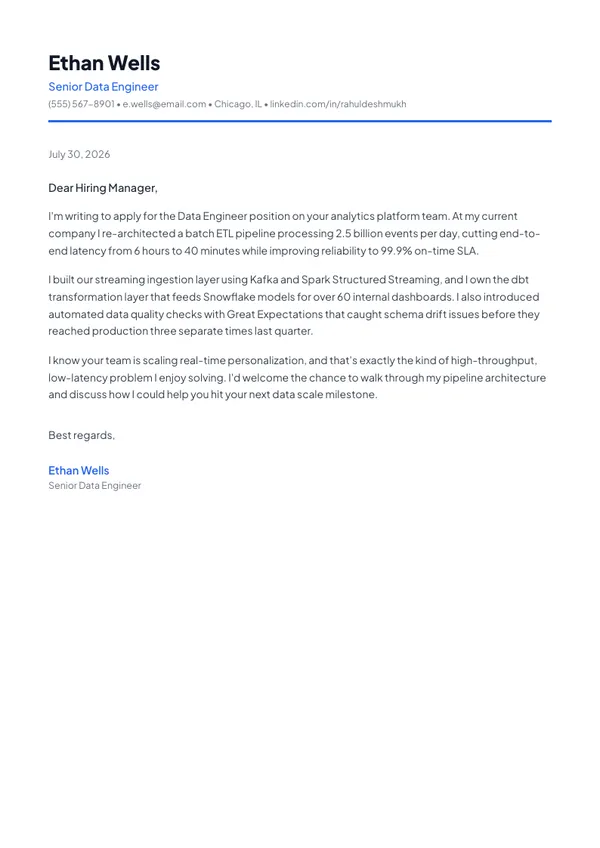
Data Engineer
Basic template
View example →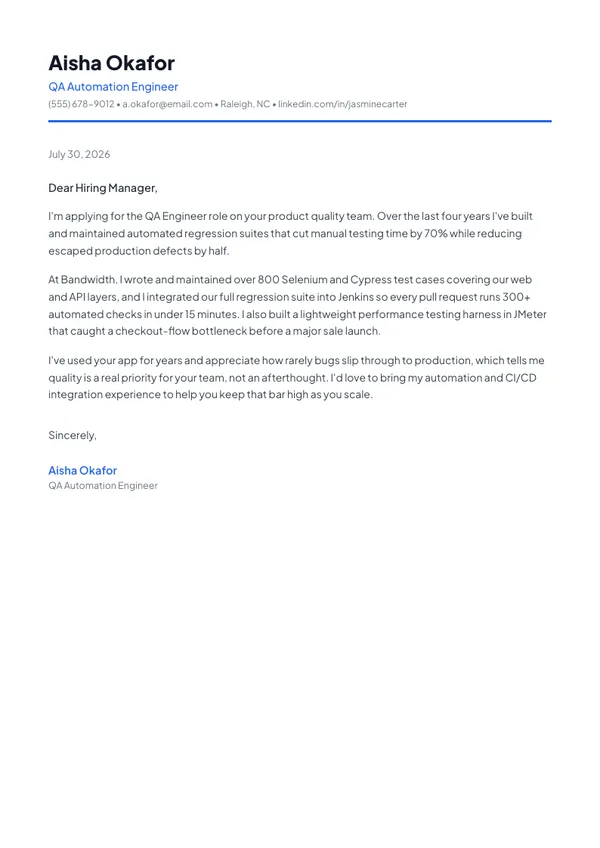
QA Engineer
Basic template
View example →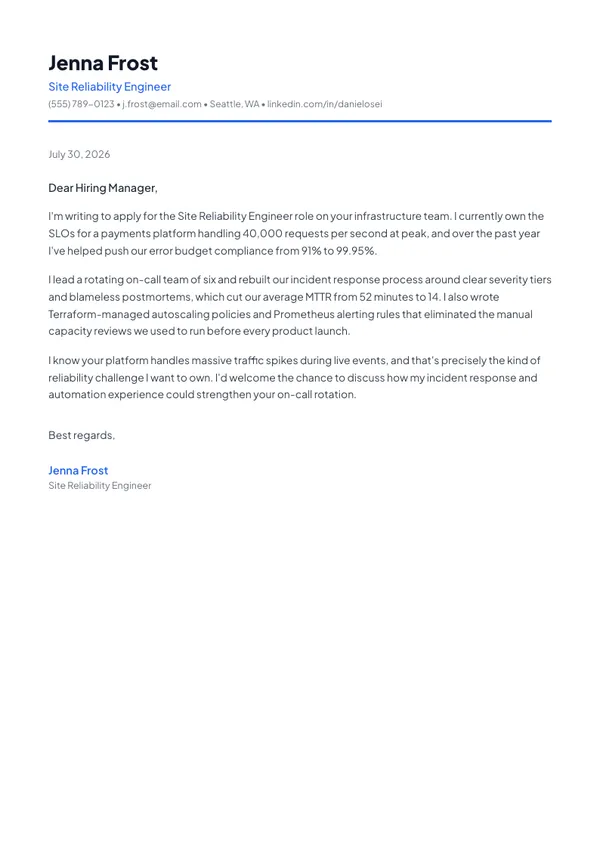
Site Reliability Engineer
Basic template
View example →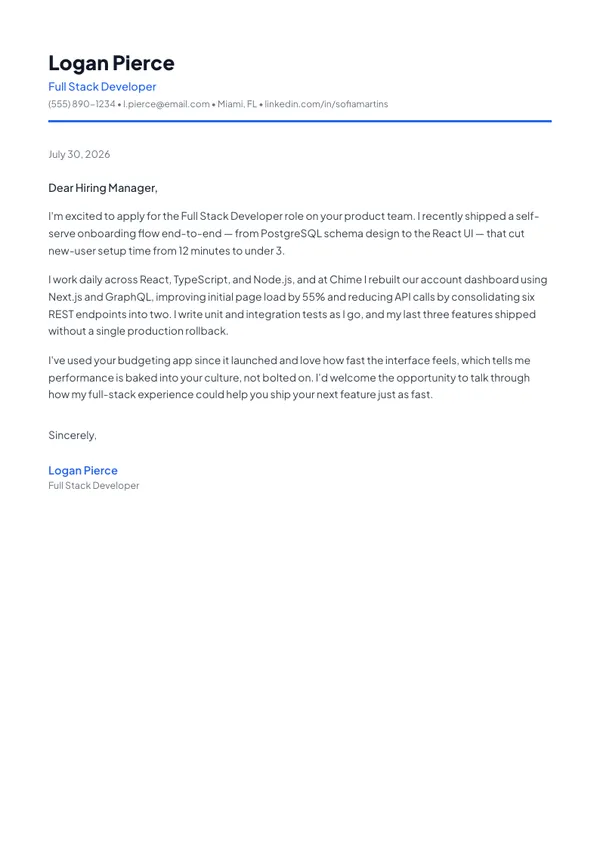
Full Stack Developer
Basic template
View example →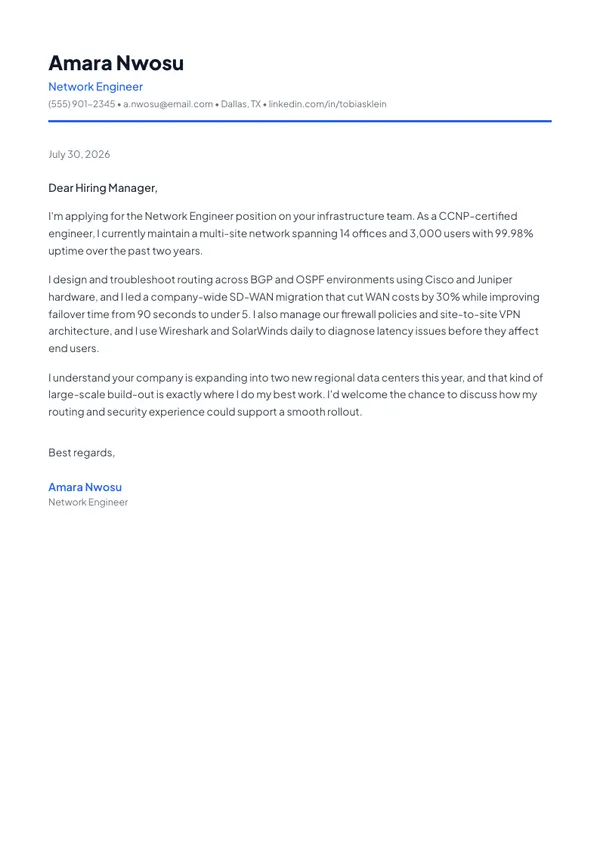
Network Engineer
Basic template
View example →What a engineering cover letter has to prove
You built or ran a system of comparable scale
Users, requests per second, sites, megawatts, kilometres of road, test cases, nodes — whatever the discipline measures. Scale is the fastest way for a hiring manager to place you at the right level.
You diagnosed and fixed something real
A failure, an outage, a defect, a structural or electrical problem — what you found, how, and what changed afterwards. Problem stories are what engineering interviews are made of; put the best one in the letter.
Your stack or discipline matches the posting, in their words
Name the languages, tools, standards and codes exactly as the posting does — Kubernetes, Terraform, AutoCAD, IEC 61850, Eurocode. Engineering postings are keyword-filtered harder than almost any other category.
You hold the licence or certification the role needs
PE or chartered status, FE/EIT, AWS or Cisco certifications, safety training, ISTQB. State them, with dates, in the body; do not make the reader hunt.
You moved a number the team cares about
Uptime, latency, cost, defect escape rate, schedule days, energy use, material cost. One quantified improvement per project you mention.
You know what they build
Their product, their infrastructure, a public project, an open-source repo, a standard they work to. One accurate sentence signals the letter was written for them.
How to structure it
- 1
Open with the role, your discipline and the strongest number
"I am applying for the Site Reliability Engineer role. For three years I have run the on-call rotation for a platform doing 30,000 requests a second at 99.95% availability." No preamble.
- 2
Describe the system and your ownership of it
What it was, what you owned, the tools, the scale. Two or three sentences a peer would recognise as real.
- 3
Tell the problem story with the result
The failure or the improvement: what you found, what you changed, the number after. This is the paragraph that gets the letter forwarded to the team lead.
- 4
Close on their work and your logistics
One specific observation about their product or project, then licence status, notice period, location or remote preference, and a direct request for a technical conversation.
Questions people ask
Do engineering managers actually read cover letters?
Fewer than in other fields, but the ones who do use them decisively. A letter that names a system, a scale and a fixed problem in the first paragraph is forwarded to the team; one that opens with soft skills is skipped. For roles with a licensing or safety component (civil, electrical, site work) and for senior roles, the letter is read much more consistently because judgement and written communication are part of the job.
How technical should the letter be?
As technical as the posting, and no more. Use the exact tool and standard names the job ad uses, because those are the keywords it will be screened for, but explain outcomes in plain terms — a manager or recruiter may read it before the engineer does. A good test: a peer should recognise the work as real, and a non-engineer should still understand what improved.
How do I write an engineering cover letter as a new graduate?
Lead with the most substantial thing you built — a capstone, an internship system, an open-source contribution, a competition entry — described as an engineering project: the problem, the constraints, the tools, what worked, what you measured. Then your EIT or certification status and the stack you are strongest in. Graduates are hired on demonstrated problem-solving and trajectory, and one well-described project shows both.
Should I link GitHub or a project portfolio?
Yes, if it shows something relevant and finished. Link the repository or project page and name what to look at, the same way a designer names a case study. A profile with one solid, documented project beats one with forty abandoned forks. For civil, electrical and mechanical roles, a short project list with photos or drawings serves the same purpose.
Is the same letter fine for a DevOps role and a civil engineering role?
No — the disciplines share almost nothing beyond the word engineer. Software and infrastructure roles are judged on systems, tooling and reliability numbers; civil and electrical roles on projects delivered, codes and standards, licensure and site safety. Start from the example for your discipline below; the structure carries over, the evidence does not.
Start from one of these engineering letters
Pick the example closest to your role, open it in the builder, and replace the details with your own.