IT & Technology Cover Letter Examples
IT hiring managers screen cover letters for systems, certifications and the incidents you have handled — usually in under a minute. These examples cover IT support, systems and database administrators, cloud and cybersecurity, data science, IT project management, business analysis and UI/UX — each a complete letter you can open in the builder and edit, written around environments run, tickets and incidents resolved, and the tools the posting names.
The IT cover letter that fails is a list of technologies. The one that works describes an environment — how many users, how many servers or endpoints, which platforms — and what happened in it: the migration you delivered, the outage you resolved, the security finding you closed, the backlog you cut. Managers hire for what you have kept running and what you have changed, and both are numbers.
Build My Cover Letter Free9 Information Technology Cover Letter Examples
Every letter below is complete and specific to its role. Open any of them in the builder and edit each line — nothing here is a placeholder.
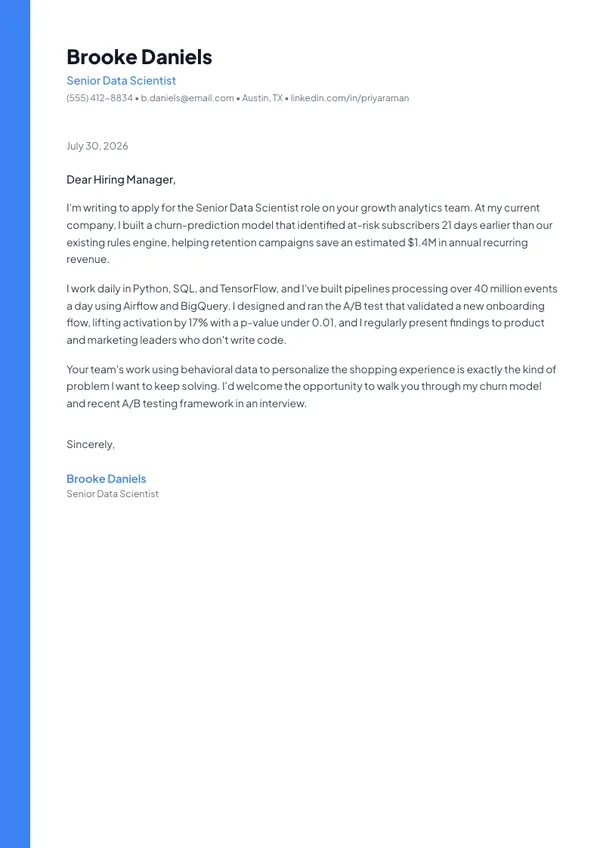
Data Scientist
Modern template
View example →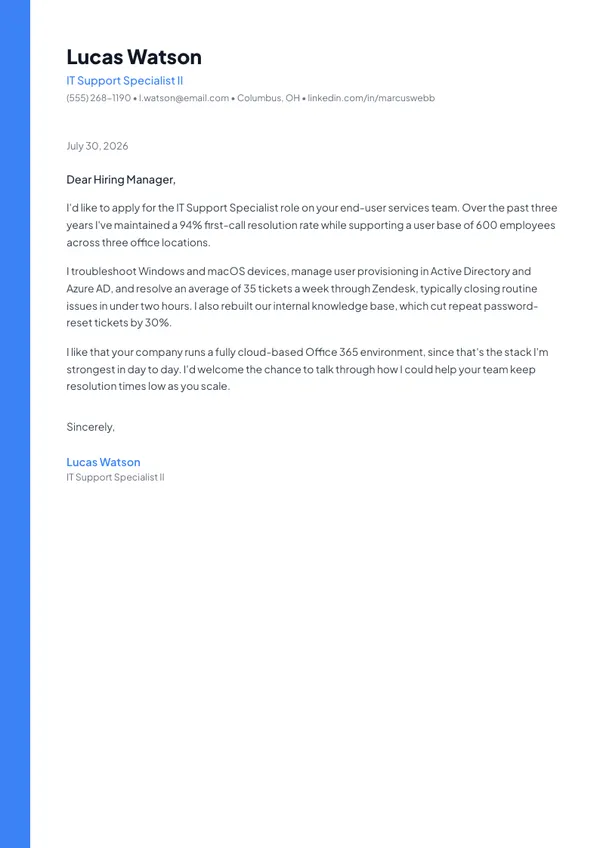
IT Support Specialist
Modern template
View example →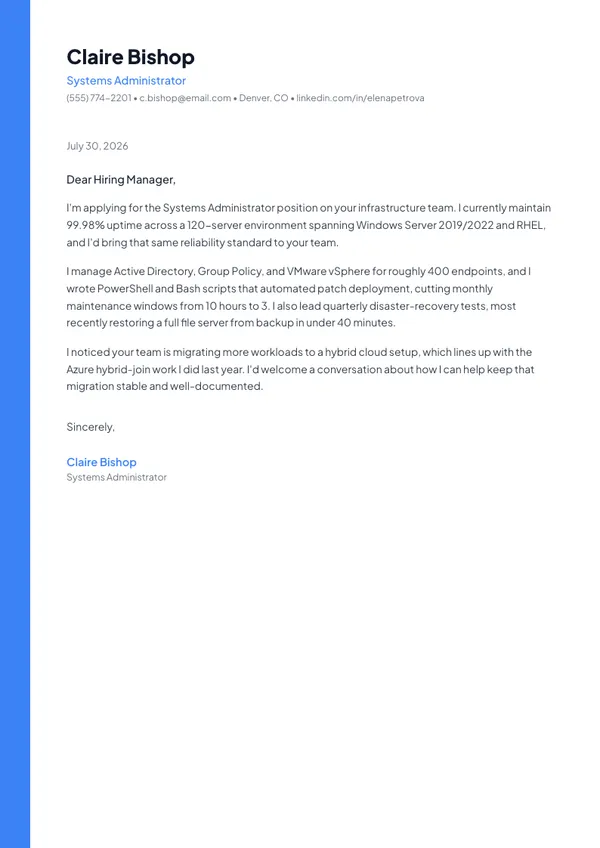
Systems Administrator
Modern template
View example →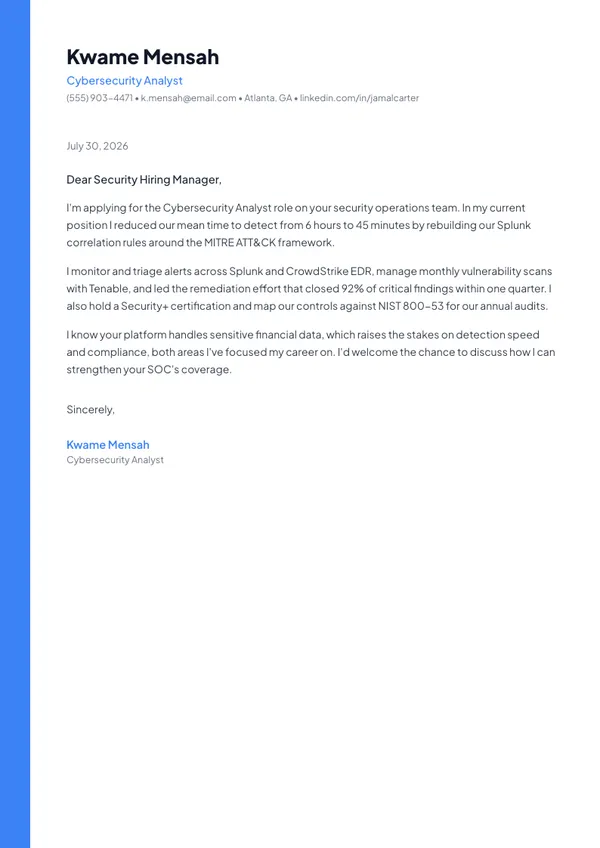
Cybersecurity Analyst
Modern template
View example →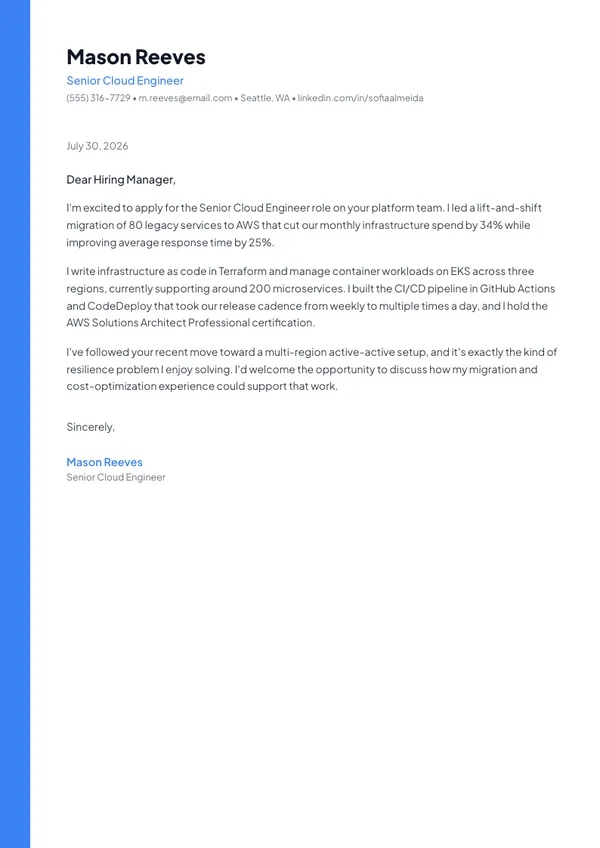
Cloud Engineer
Modern template
View example →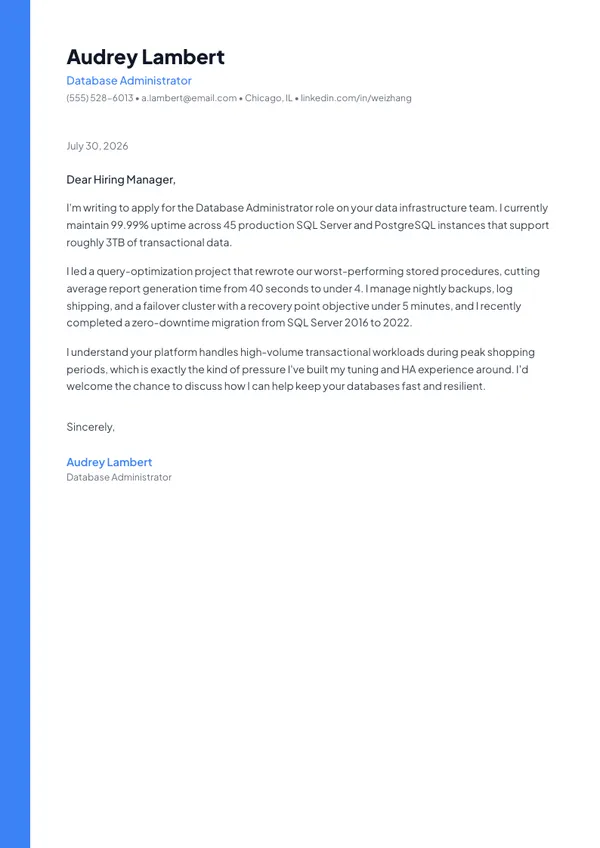
Database Administrator
Modern template
View example →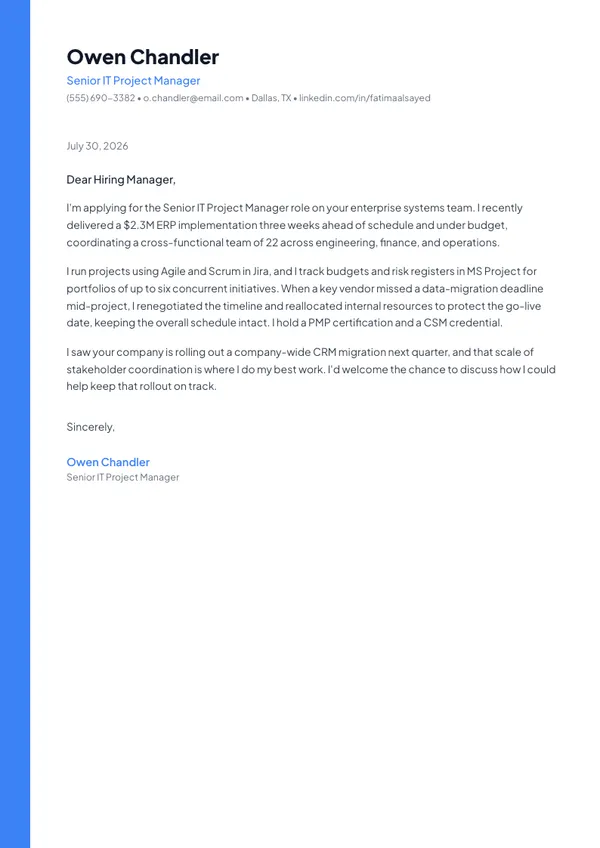
IT Project Manager
Modern template
View example →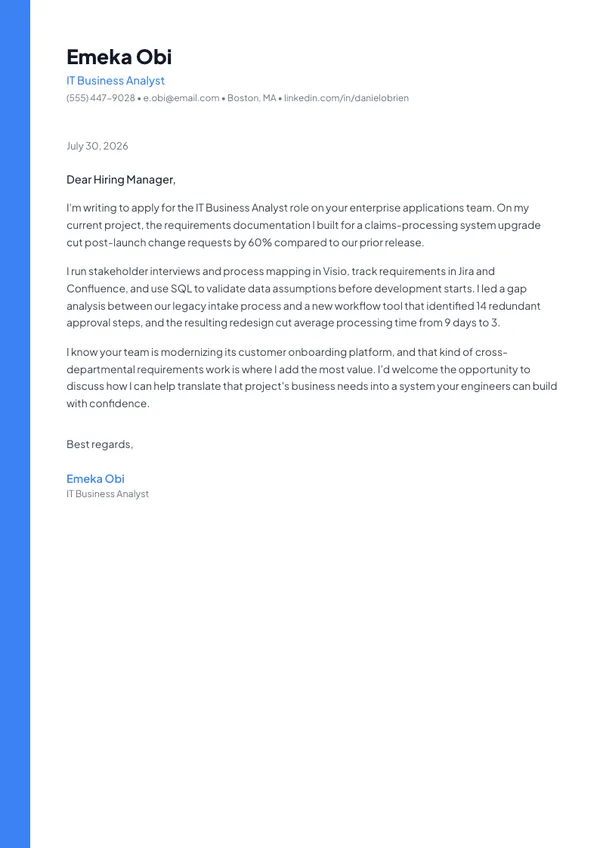
IT Business Analyst
Modern template
View example →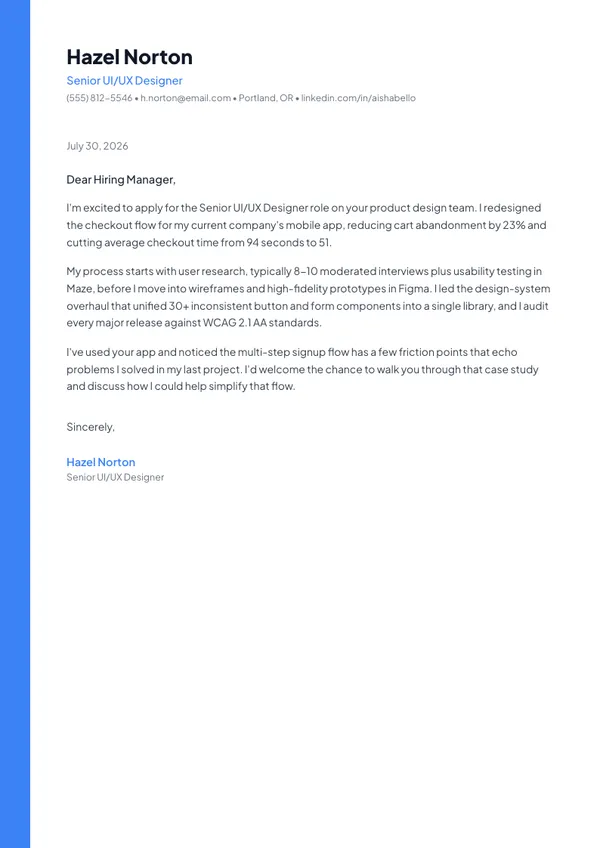
UI/UX Designer
Modern template
View example →What a information technology cover letter has to prove
You have run an environment of their size
Users supported, endpoints managed, servers or cloud accounts administered, data volume, ticket volume. Scale tells the reader whether you are a fit for a 50-seat office or a 5,000-seat enterprise.
You resolved incidents or delivered changes with a measurable result
Mean time to resolve, ticket backlog reduced, uptime achieved, a migration completed on schedule, a vulnerability count cut. One number per story.
Your certifications and platforms match the posting exactly
CompTIA, Microsoft, AWS, Azure, Cisco, CISSP, ITIL, PMP — and the platforms: Active Directory, M365, Linux, VMware, ServiceNow. IT postings are among the most keyword-filtered; use their spelling.
You can talk to the people the systems serve
A user group you trained, a stakeholder you gathered requirements from, a manager you reported to. IT roles are judged on communication because every incident involves someone who is not technical.
You work inside process and security discipline
Change management, ITIL practices, access control, backups tested, documentation kept. The phrase "documented the runbook" is worth more to an IT manager than any soft skill.
You know their stack or sector
A platform they run, a compliance regime they answer to (HIPAA, PCI, SOC 2), a product they ship. One specific sentence proves the letter is theirs.
How to structure it
- 1
Open with the role, your certification and the environment you run
"I am applying for the Systems Administrator position. I am Microsoft- and AWS-certified and currently administer a 1,200-user hybrid environment across two data centres and three AWS accounts."
- 2
Describe the environment and what you own in it
Platforms, scale, the responsibilities that are yours. Match the posting’s list of duties with your actual experience of each.
- 3
Give the incident, migration or project with its result
What broke or what changed, what you did, the number after. This is the story the hiring manager will ask for in the interview; putting it in the letter earns the interview.
- 4
Close on their environment and your availability
One specific observation about their stack, sector or a public project, then notice period, on-call availability if relevant, and a direct request to talk.
Questions people ask
Do IT managers actually read cover letters?
For support and administration roles, often only when the resume is borderline; for security, cloud, data and project roles, more consistently. In both cases a letter that opens with the environment you run and one incident you resolved is read to the end, and one that opens with soft skills is not. Use it to add what the resume cannot hold: the story of a fix, a migration, a finding, and the context of scale.
Should I list every technology I know?
No. List the ones the posting names, spelled the way it spells them, in the context of work you actually did with them. A letter that recites forty tools reads as padding and hides the three that matter. The full inventory belongs in the resume skills section, where the applicant tracking system reads it; the letter should show depth on the handful the role is built around.
How do I write an IT cover letter with only help-desk or home-lab experience?
Describe the help-desk work with numbers — tickets per week, first-contact resolution rate, the systems you supported — and treat the home lab as a project: what you built, what it runs, what you learnt when it broke. Then your certifications, including exam dates for any in progress. IT is one of the few fields where self-directed technical work is taken seriously if it is described precisely.
How do I show security or compliance experience without naming incidents?
Describe controls and outcomes rather than events: the audit you prepared for and passed, the framework you implemented, the vulnerability backlog you reduced by a percentage, the access review you ran. Security teams understand that incidents are confidential; they want to see that you know the frameworks and have operated inside them.
Is the same letter fine for a support role and a cloud engineering role?
No. Support letters are judged on volume, resolution rates and user communication; cloud and infrastructure letters on architecture, automation, cost and reliability; data and analytics letters on pipelines, models and decisions changed. The environment paragraph and the incident story should be written for the specific role. Start from the matching example below.
Start from one of these information technology letters
Pick the example closest to your role, open it in the builder, and replace the details with your own.