Finance & Accounting Cover Letter Examples
Finance and accounting hiring managers read a cover letter the way they read a ledger: looking for what does not reconcile. These examples cover the roles most often hired — staff and senior accountant, financial analyst, bookkeeper, accounts payable and receivable, controller, internal auditor, tax accountant and finance manager — and each is a complete letter you can open in the builder and edit.
An accounting cover letter is judged on precision before persuasion. A single vague sentence ("responsible for the monthly close") reads as a candidate who does not own the numbers, while "closed the books by working day five, down from nine, across three entities" reads as one who does. The examples below are written the way controllers think: close cycles, reconciliation counts, audit findings, filings, and the systems the work ran on.
Build My Cover Letter Free10 Finance & Accounting Cover Letter Examples
Every letter below is complete and specific to its role. Open any of them in the builder and edit each line — nothing here is a placeholder.
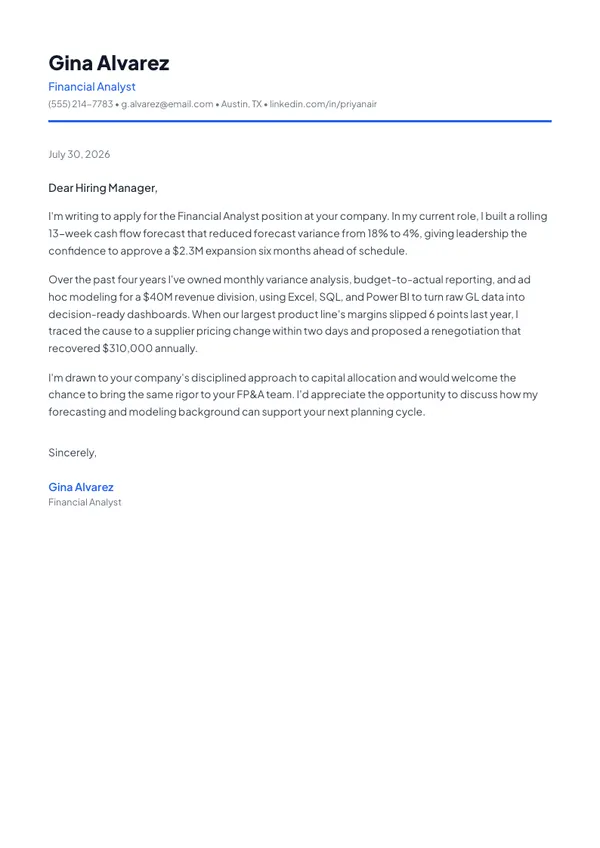
Financial Analyst
Basic template
View example →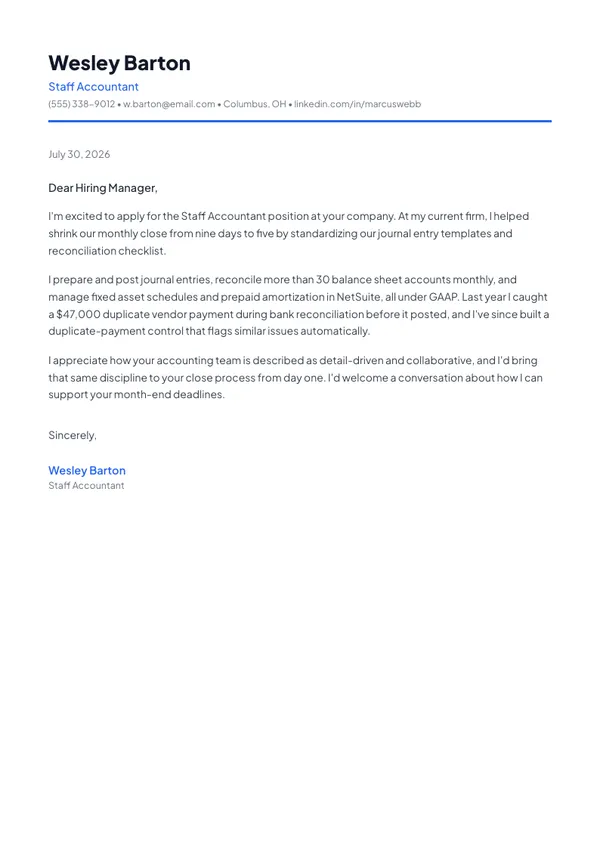
Staff Accountant
Basic template
View example →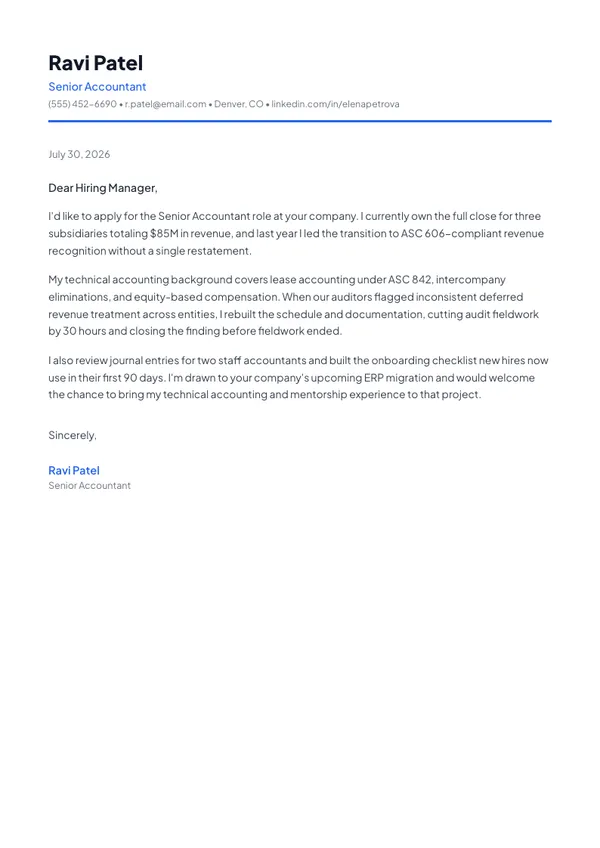
Senior Accountant
Basic template
View example →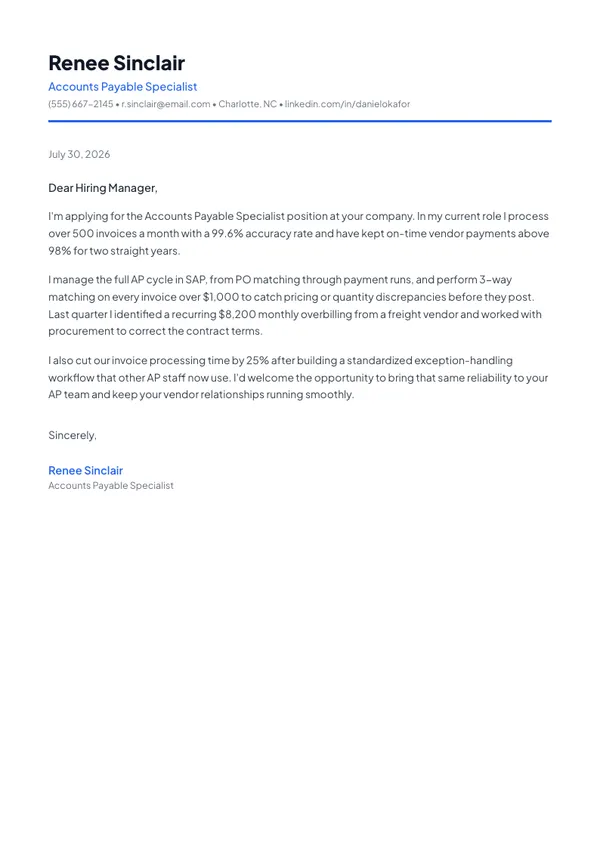
Accounts Payable Specialist
Basic template
View example →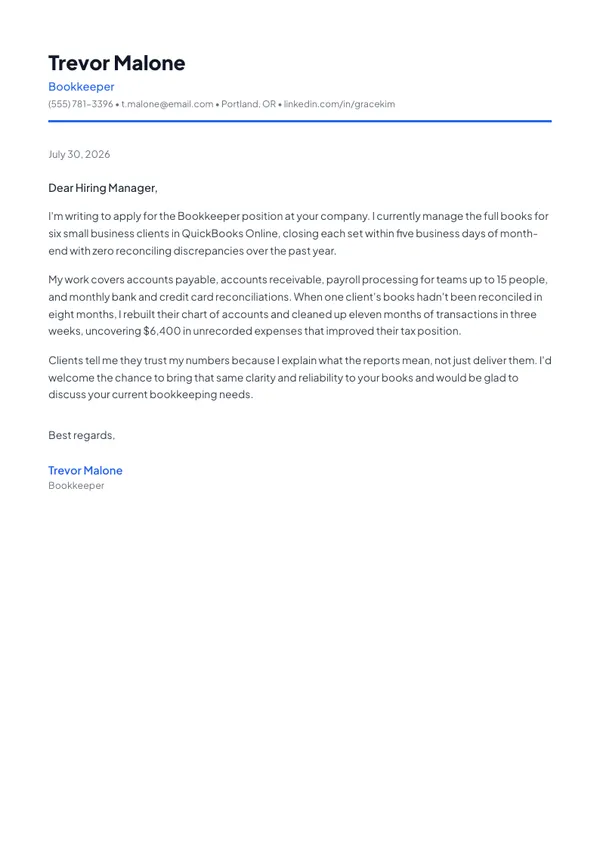
Bookkeeper
Basic template
View example →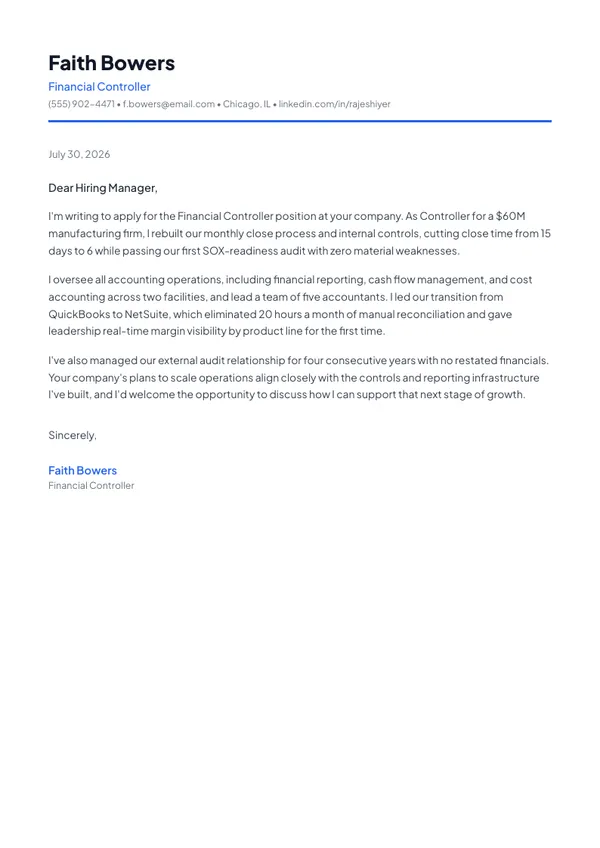
Financial Controller
Basic template
View example →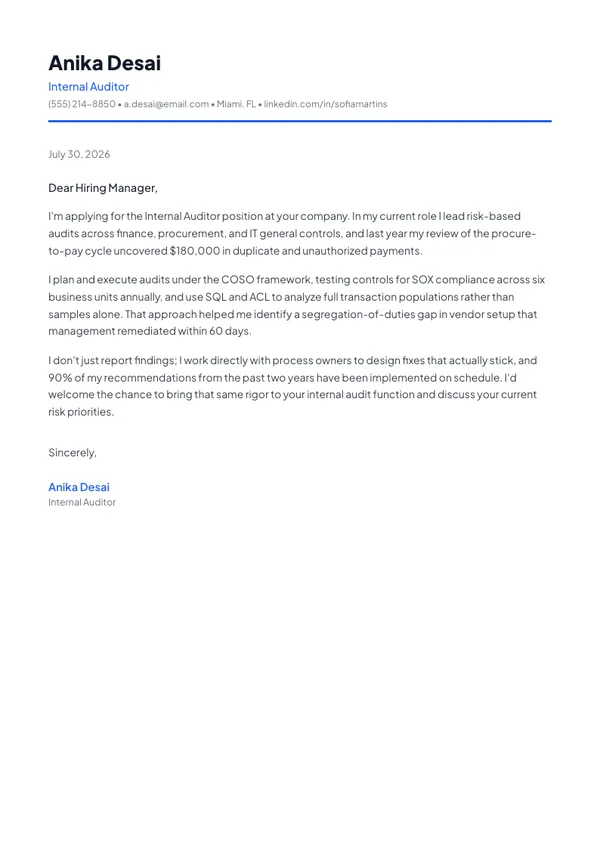
Internal Auditor
Basic template
View example →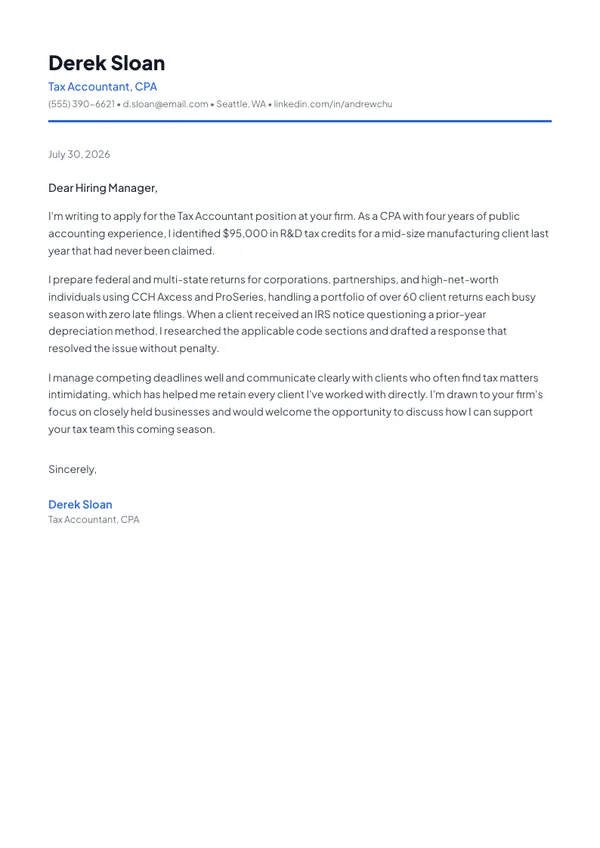
Tax Accountant
Basic template
View example →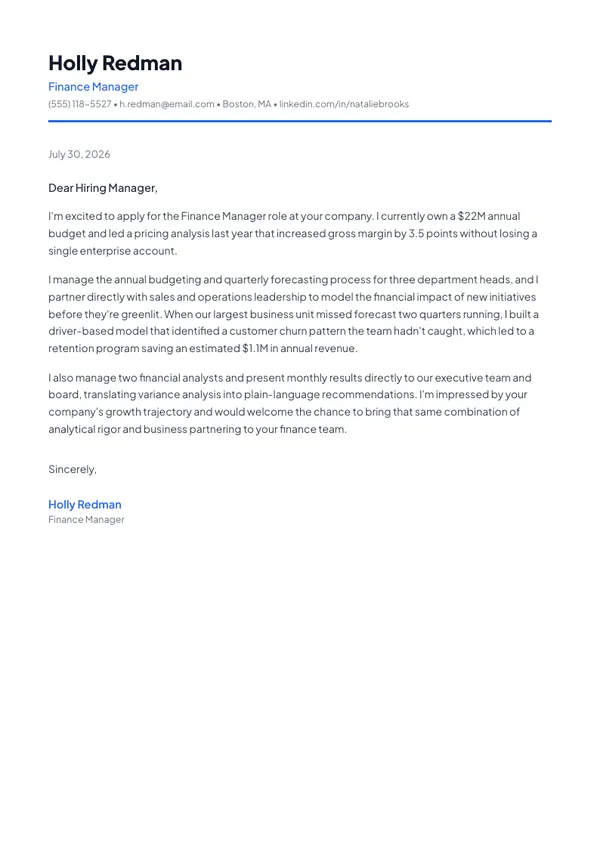
Finance Manager
Basic template
View example →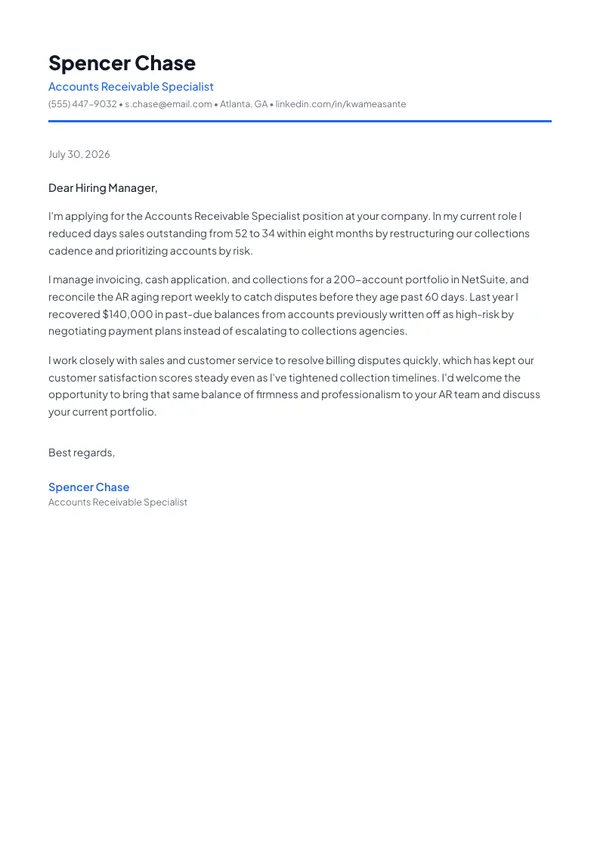
Accounts Receivable Specialist
Basic template
View example →What a finance & accounting cover letter has to prove
You own a close, a reconciliation or a filing — with dates
Name the cycle and your part in it: month-end close by day five, forty bank and GL reconciliations a month, quarterly GST or sales-tax filings, year-end audit schedules. Time-bound ownership is the currency of this industry.
You have handled real volume or real money
Invoices processed per month, the size of the AP run, the revenue you accounted for, the budget you analysed. Scale tells the reader which tier of role you are ready for.
You found something
The duplicate vendor payment you caught, the variance you traced, the control gap you closed, the tax position you corrected. One recovered or prevented number is worth more than a paragraph on attention to detail.
You know their systems and standards
Name the ERP and tools (SAP, Oracle, NetSuite, QuickBooks, Tally, Excel at the level you actually use it) and the framework — GAAP, IFRS, Ind AS, SOX. Systems are often the first ATS filter in finance postings.
You hold, or are sitting, the credential the role expects
CPA, CA, CMA, ACCA, EA, or the exam stage you are at. Say it plainly and early; a hiring manager should never have to search the resume to find out.
You can explain a number to someone who is not an accountant
Finance roles increasingly sit next to operations and leadership. One sentence about presenting variance analysis to a department head, or turning a board pack into decisions, shows you are more than a producer of schedules.
How to structure it
- 1
Open with the role, the credential and one hard number
"I am applying for the Senior Accountant position. I am a CPA who has run a five-day close for a $40M distributor for three years." That is the whole first paragraph.
- 2
Walk through the close, the controls or the analysis you own
Two or three sentences on what you are responsible for and the scale of it, in the vocabulary the posting uses — accruals, reconciliations, variance, consolidation, filings.
- 3
Give the one time you caught or fixed something
The error, the amount, the control you added. This paragraph is the interview question they will ask anyway; answering it first makes you the candidate they want to meet.
- 4
Close on their business and your availability
One accurate sentence about their industry or a recent event (an acquisition, a new entity, a system migration), then notice period and a direct request for a conversation.
Questions people ask
Do accounting firms and finance teams actually read cover letters?
More than most industries. Accounting resumes are close to interchangeable — the same software, the same duties, the same certifications — so the letter is where a controller learns whether you ran a close or assisted with one, and whether you have ever caught an error that mattered. For roles at CPA firms and in corporate finance the letter is often the first filter for written communication, which the job itself demands daily.
Should I mention my CPA or CA status if I have not passed all the exams?
Yes, precisely. "CPA candidate, two of four sections passed, sitting REG in November" is a positive signal that tells the reader exactly where you are and that you are progressing. Vagueness ("pursuing CPA") reads as stalled. The same applies to CA Inter and Final, CMA, ACCA and EA — state the stage and the next exam date.
How do I write a finance cover letter with no experience?
Lead with what you have handled that involved money and accuracy: an internship where you reconciled accounts, a treasurer role in a student organisation with a real budget, a bookkeeping job for a family business, coursework in audit or tax with a specific project. Name the software you have used, even if it was in class. Then state the credential path you are on. Entry-level finance hiring is about rigour and trajectory, not tenure.
How much detail about the numbers is too much?
Three to five figures in the whole letter is right: the size of what you managed, one cycle time, one thing you found, one improvement. More than that and the letter reads like a schedule. Choose the numbers that match the posting — an AP role wants invoice volume and payment accuracy, an FP&A role wants budget size and forecast variance, an audit role wants engagements and findings.
Is the same letter fine for an accountant role and a financial analyst role?
No. Accounting roles are judged on control, accuracy and cycle discipline; analyst roles on modelling, forecasting and the decisions your analysis changed. The evidence is different and so is the vocabulary. Start from the example for the specific role below — a staff accountant letter and a financial analyst letter should not share a middle paragraph.
Start from one of these finance & accounting letters
Pick the example closest to your role, open it in the builder, and replace the details with your own.